Yokozuna Asashoryu finished off the year with a 15-0 zensho yusho (all-wins championship) in the Kyushu basho (tournament). He sewed up the trophies yesterday, so the only question today was whether he would get his fifth perfect record or not. He was up against Chiyotaikai an ozeki with a solid tournament going. (Not sure what the heck I'm talking about? Click the links, should be obvious.) Chiyo blasted out of the tachiai, had Asa back on his heels and reeling, and stuck his elbow in Asa's throat and starting pushing. Asa slid all the way back to the bales at the edge of the ring, teetered there... and for some inexplicable reason, Chiyo pulled his elbow out of Asa's neck and tried to wrap his arm around Asa's shoulders. That was all the opening Asa needed. He slipped under Chiyo's arm, came around the side, and picked Chiyo up and put him down outside the ring. Chiyo, at 160kg (350 pounds), is probably intermediate weight for a sumo wrestler, but picking up a guy that size who doesn't want to be picked up is quite a trick.
Asashoryu is the perfect sumo wrestler. If I could pick one adjective to describe him, it would be "fierce". He hates to lose, concentrates incredibly well, is never intimidated, and goes all out, every match. He has technique, he has strength -- his shoulders and legs are incredible. He has unreasonable amounts of speed for a guy 148kg -- lose contact with him for a fraction of a second, and he's around your side, and it's all over. But above all, he has that fierce will to win.
He said yesterday, after his win guaranteed him the Emperor's Cup, "I am my own rival." Some say he does so well because he has no competition; the ozeki are all bumblers, over the hill, or injured most of the time. I say Asa is just plain better than they are. I've watched Konishiki, Takanohana, Wakanohana, Musashimaru, and Akebono many times, and while it would be entertaining to watch Asa go up against one of them in his prime, my money right now is on Asa as the best wrestler of the last fifteen years. Koni-chan and Maru had that immovable bulk (and Maru a fierceness of his own), Taka that beautiful technique, Ake that long, long leverage -- but I'll take Asa. His strength is a clear step above Taka, who is perhaps next on the list, and I think his technique is as good (that page above lists nineteen techniques used in his last six tournaments (67 wins) -- great versatility, since the ozeki run nine to fifteen, albeit for smaller win totals). Both know how to win the big matches; Taka perhaps had more of them that Asa has had so far, but I think Asa is his equal in ability to win them.
In 2005, Asa's record was 84-6, and he won all six tournaments. In my opinion, he was sportsman of the year for the entire planet. 2006 has not gone quite as well due to an injury mid-year, but when healthy (as he usually is -- nothing seems to nag at him) he has no rivals. Except, of course, himself.
Sunday, November 26, 2006


Beautifying Kyoto
Today's Daily Yomiuri contains evidence of the visual blight of Japan that Alex Kerr talks about in his fantastic book Dogs and Demons. A front page article says that Kyoto will ban flashing neon signs atop buildings, starting next year and going into effect over the next six years. Kerr has watched the decay of Kyoto's beauty since the 1960s, and must be saying that this move is far overdue. The city should, by all rights, be a charming, quiet place, good for strolling narrow streets with old houses and traditional restaurants. Instead, except for the neighborhoods of Pontocho and the Philosopher's Walk, most of it is rather garish, especially at night, combined with some world-class ugly buildings. The Japan advertising association naturally says it's not the only ones to blame, as if that's a good enough reason not to fix one of the worst problems. Kyoto will also lower the maximum allowable height of new buildings, especially around Kyoto's world heritage sites.
Then, on page 3 of the DY, there is a picture of the proposed New Tokyo Tower, to be the world's tallest transmission tower when it is finished in 2011. Designed by Tadao Ando (arguably Japan's best and most famous architect, and deservedly so -- he does some beautiful things with curved concrete that work wonderfully in their environment, rather than simply destroying it) and sculptor Kiichi Sumikawa. The tower will be triangular at the bottom, round at the top. Personally, I'm not sure it's needed.
Then, on page 3 of the DY, there is a picture of the proposed New Tokyo Tower, to be the world's tallest transmission tower when it is finished in 2011. Designed by Tadao Ando (arguably Japan's best and most famous architect, and deservedly so -- he does some beautiful things with curved concrete that work wonderfully in their environment, rather than simply destroying it) and sculptor Kiichi Sumikawa. The tower will be triangular at the bottom, round at the top. Personally, I'm not sure it's needed.
Friday, November 24, 2006
IIJ "Improves" Their Service
IIJ, Internet Initiative Japan, is one of the oldest and most respected ISPs in the country. I've never used anyone else. But the day before yesterday, they implemented an "improvement" to their network that has me looking for another ISP.
With no prior announcement that I saw, they started blocking outbound SMTP. This means that, all of a sudden, I can't send email from my house, except by using some web-based mail system such as Gmail.
I use three different email accounts that I need outbound SMTP access for. I called their service line, and the woman I talked to suggested that I get them to open up SMTP on another port. Ugh. Like that would solve anything, even if I could get them to do it.
I threatened to cancel my service, and she said that any other ISP I can find will likely either already have port 25 blocked, or be doing so in the near future. It's an anti-spam measure recommended by the Japan Email Anti-Abuse Group (JEAG).
I haven't been this angry about some utility in a long time...
With no prior announcement that I saw, they started blocking outbound SMTP. This means that, all of a sudden, I can't send email from my house, except by using some web-based mail system such as Gmail.
I use three different email accounts that I need outbound SMTP access for. I called their service line, and the woman I talked to suggested that I get them to open up SMTP on another port. Ugh. Like that would solve anything, even if I could get them to do it.
I threatened to cancel my service, and she said that any other ISP I can find will likely either already have port 25 blocked, or be doing so in the near future. It's an anti-spam measure recommended by the Japan Email Anti-Abuse Group (JEAG).
I haven't been this angry about some utility in a long time...
Wednesday, November 15, 2006
Tsunami
I'm watching a news press briefing right now about the tsunami. It was triggered by an 8.1 earthquake several hundred km northeast of the northeastern tip of Hokkaido, the northernmost of the four major islands of Japan.
The earthquake was felt only mildly in Hokkaido and not at all in Tokyo; I wouldn't even have known about it except that I happened to check a news website before going to bed.
The threat is quite serious, and is being treated so, but at this particular moment the only reports of activity are in the 20-40cm range. That's big enough to create serious water coming onshore; they said that the height can be amplified two to ten times that when it hits land, depending on conditions.
All of the TV stations except the shopping channels (which probably run only canned material) have a map of Japan with flashing coastline covering most of Hokkaido and the eastern coast of Honshu all the way down from Tohoku, past Chiba and Tokyo down to about Nagoya. But they are saying that the size and threat are smaller down here.
We live high enough and far enough inland that we're in no danger, and neither are our friends, but there are plenty of people close enough to the coast to worry about.
The predicted time of the earliest arrival has come and gone for the northern part of the country with no major waves reported, but we're not out of the woods yet...
Someone (the head?) of the meteorological agency is giving a briefing at this moment...
The earthquake was felt only mildly in Hokkaido and not at all in Tokyo; I wouldn't even have known about it except that I happened to check a news website before going to bed.
The threat is quite serious, and is being treated so, but at this particular moment the only reports of activity are in the 20-40cm range. That's big enough to create serious water coming onshore; they said that the height can be amplified two to ten times that when it hits land, depending on conditions.
All of the TV stations except the shopping channels (which probably run only canned material) have a map of Japan with flashing coastline covering most of Hokkaido and the eastern coast of Honshu all the way down from Tohoku, past Chiba and Tokyo down to about Nagoya. But they are saying that the size and threat are smaller down here.
We live high enough and far enough inland that we're in no danger, and neither are our friends, but there are plenty of people close enough to the coast to worry about.
The predicted time of the earliest arrival has come and gone for the northern part of the country with no major waves reported, but we're not out of the woods yet...
Someone (the head?) of the meteorological agency is giving a briefing at this moment...
Tuesday, November 14, 2006
IPW2200 on FC6
Sorry, I still haven't written up my full notes on getting Fedora Core 6 running on my Sony Vaio Type T laptop, but one tidbit:
Sometimes when I boot, the initialization of the IPW2200 builtin WLAN interface doesn't happen properly. This symptom is this:
and networking fails to work. This condition sometimes persists over reboots, it seems, though as far as I can tell it's just a random phenomenon, so I don't know why it would persist.
The solution is:
Hope this helps somebody; meantime, if any of you know why it's happening and how to stop it from happening, let me know.
Sometimes when I boot, the initialization of the IPW2200 builtin WLAN interface doesn't happen properly. This symptom is this:
[rdv@localhost ~]$ iwconfig
lo        no wireless extensions.

__tmp1804289383  IEEE 802.11g  ESSID:"xxxx"
          Mode:Managed  Frequency:2.462 GHz  Access Point: 00:07:40:xx:xx:xx
          Bit Rate:54 Mb/s   Tx-Power=20 dBm   Sensitivity=8/0
          Retry limit:7   RTS thr:off   Fragment thr:off
          Power Management:off
          Link Quality=62/100  Signal level=-63 dBm  Noise level=-85 dBm
          Rx invalid nwid:0  Rx invalid crypt:0  Rx invalid frag:0
          Tx excessive retries:0  Invalid misc:482   Missed beacon:20

eth0      no wireless extensions.

sit0      no wireless extensions.
and networking fails to work. This condition sometimes persists over reboots, it seems, though as far as I can tell it's just a random phenomenon, so I don't know why it would persist.
The solution is:
[root@localhost rdv]# rmmod ipw2200
[root@localhost rdv]# modprobe !$
modprobe ipw2200
[root@localhost rdv]# iwconfig
lo        no wireless extensions.

eth0      no wireless extensions.

sit0      no wireless extensions.

eth1      IEEE 802.11g  ESSID:"xxxx"
          Mode:Managed  Frequency:2.462 GHz  Access Point: 00:07:40:xx:xx:xx
          Bit Rate:54 Mb/s   Tx-Power=20 dBm   Sensitivity=8/0
          Retry limit:7   RTS thr:off   Fragment thr:off
          Encryption key:off
          Power Management:off
          Link Quality=67/100  Signal level=-60 dBm  Noise level=-86 dBm
          Rx invalid nwid:0  Rx invalid crypt:0  Rx invalid frag:0
          Tx excessive retries:0  Invalid misc:0   Missed beacon:10
Hope this helps somebody; meantime, if any of you know why it's happening and how to stop it from happening, let me know.
Thursday, November 09, 2006
Hello, Dali
I had the day off yesterday, and went to the Ueno Go Club (first time) and the Salvador Dali Centennial Exhibition at the Ueno Mori Museum. The exhibit is well worth seeing, something like a hundred of his works, starting from his teens and going into the 1980s. I was surprised to see some Cubist works (in both form and palette) in his early period. If this exhibition is any judge, surrealism sprang from his head full-blown in about 1927; I didn't see anything I'd consider a "transitional" work.
The logistics aren't perfect. His pencil sketches are dimly lit, presumably to protect the paper, but that makes them difficult to appreciate. And he painted a couple of stereo pairs which are very large; it's impossible to get far enough away from them to cross your eyes and see the stereo effect without a crowd gathering between you and the paintings.
Speaking of which, though it was a Wednesday afternoon, the museum was crowded. Go early.
The catalog appears to be only in Japanese, though the works were all titled in both English and Japanese. Some of the quotes on the wall were in English, some in Spanish, all translated into Japanese. But for paintings, at least, an English explanation is optional; we recently went to see the exhibit of Chinese terra-cotta warriors at the Tokyo-Edo Museum, and that also had no English, which would definitely leave you lost if you couldn't read Japanese. "What the heck is that? When was it made?" Those are important questions for historical artifacts.
Anyway, Dali is there until Jan. 4. Don't wait!
The logistics aren't perfect. His pencil sketches are dimly lit, presumably to protect the paper, but that makes them difficult to appreciate. And he painted a couple of stereo pairs which are very large; it's impossible to get far enough away from them to cross your eyes and see the stereo effect without a crowd gathering between you and the paintings.
Speaking of which, though it was a Wednesday afternoon, the museum was crowded. Go early.
The catalog appears to be only in Japanese, though the works were all titled in both English and Japanese. Some of the quotes on the wall were in English, some in Spanish, all translated into Japanese. But for paintings, at least, an English explanation is optional; we recently went to see the exhibit of Chinese terra-cotta warriors at the Tokyo-Edo Museum, and that also had no English, which would definitely leave you lost if you couldn't read Japanese. "What the heck is that? When was it made?" Those are important questions for historical artifacts.
Anyway, Dali is there until Jan. 4. Don't wait!
Tuesday, November 07, 2006
Fedora Core 6 on a Sony VAIO Type T Laptop
One of the most popular entries on my blog right now is the one on getting cpuspeed working right on a Linux laptop. I am almost done with my upgrade to Fedora Core 6 (FC6), and it was significantly painful. I'll give you the gory details in a few days (assuming I get around to it), but for the moment you probably need to know this: anaconda (the Fedora installer) sometimes installs the wrong kernel. My eventual solution involved installing the .src.rpm for the kernel and recompiling to get the p4-clockmod module to regulate CPU speed properly, but just as I was getting that process really under way a friend pointed out a note on livna.org which leads to the bug description.
I had considered removing the running kernel from my machine and installing (or just forcing) the right package off of the DVD, but worried that it had the potential to trash my machine, so I elected to do a kernel rebuild instead (always good practice, anyway). However, others are reporting that the remove and install works for them.
I also took the opportunity to do things like specify that the console resolution is 1280x768 on my machine, but AFAICT, that had no effect.
More later, but this may help somebody right away...
I had considered removing the running kernel from my machine and installing (or just forcing) the right package off of the DVD, but worried that it had the potential to trash my machine, so I elected to do a kernel rebuild instead (always good practice, anyway). However, others are reporting that the remove and install works for them.
I also took the opportunity to do things like specify that the console resolution is 1280x768 on my machine, but AFAICT, that had no effect.
More later, but this may help somebody right away...
Sunday, November 05, 2006
Zen 747
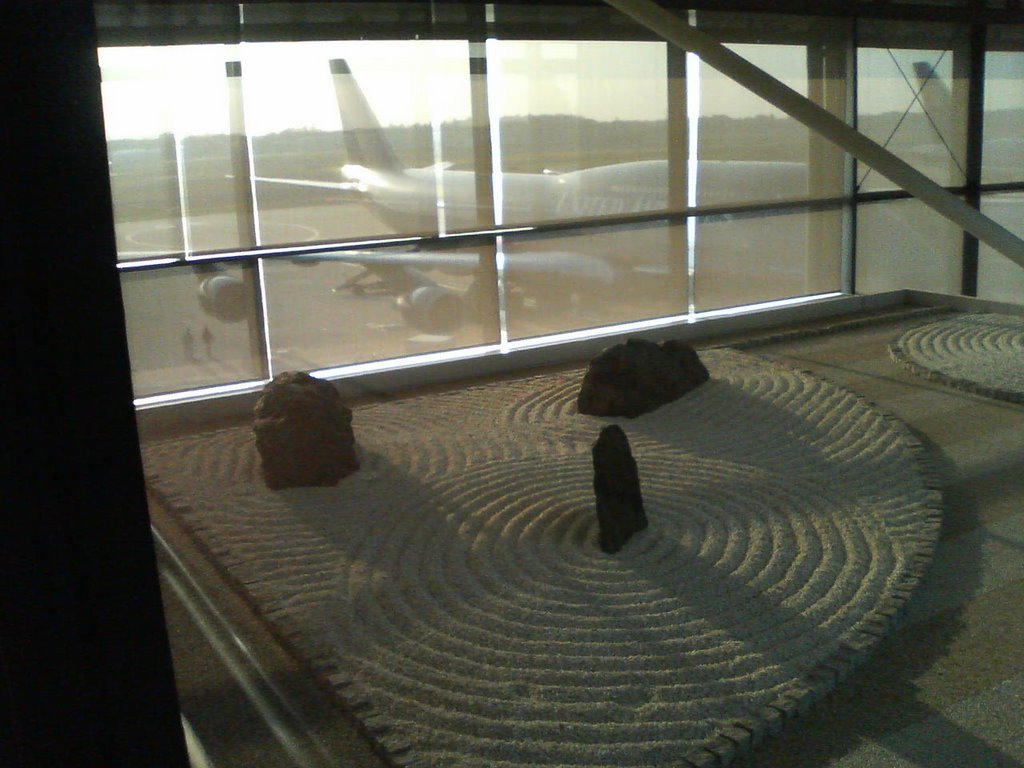
I look at this in a different light after reading Alex Kerr's Dogs and Demons, but it's still one of the cool things about living in Japan, running into unexpected things tucked into corners, like a zen rock garden on the roof of an internal structure in the terminal at Narita Airport.
Caltech's 100 CS Questions
Caltech, like most U.S. universities, has a qualifying exam that you must pass during your Ph.D. studies, generally around the time you finish classes and begin serious research. At Caltech, it's an oral exam, and the examiners can ask you anything. Adam posted the 100 key questions from 1998. They cover graphics; numerical analysis; continuous math; theory; algorithms; predicate calculus, program semantics and complexity; concurrent systems; hardware; databases and directories; and programming languages.
And, as Adam says, "The candidate should be able to leap tall buildings, outrun speeding bullets and be able not only to forsee [sic] the future, but control it."
The list very definitely represents the interests of the faculty. If you're not interested in one of those topics, you shouldn't be at Caltech; it's still a small, eclectic place (which, IMHO, is to its benefit). There are a couple of questions on the Internet, and some of the basics of operating systems are incorporated into concurrent systems, but there's very little that's directly related to the last twenty years of my life: the words virtual, disk, storage, memory, cache, file, mobile, and even architecture appear nowhere in the list (though some of them could plausibly appear in the answers to some questions).
The list is intimidating, but you have about two years to prepare for the exam, and much of that two years will be spent in classes that will answer most of those questions. In preparing for the test, you've probably already covered half the material or more, so an hour for each of those questions should be plenty of review; the other half you probably need a half a day to a day in the library for each question. Total, 2-3 months of hard prep work for your quals seems like a reasonable expectation.
This is roughly the era my pal Eve Schooler, who was a student of Mani Chandy's, was probably taking her quals. I should ask her how much of an ordeal it was...
And, as Adam says, "The candidate should be able to leap tall buildings, outrun speeding bullets and be able not only to forsee [sic] the future, but control it."
The list very definitely represents the interests of the faculty. If you're not interested in one of those topics, you shouldn't be at Caltech; it's still a small, eclectic place (which, IMHO, is to its benefit). There are a couple of questions on the Internet, and some of the basics of operating systems are incorporated into concurrent systems, but there's very little that's directly related to the last twenty years of my life: the words virtual, disk, storage, memory, cache, file, mobile, and even architecture appear nowhere in the list (though some of them could plausibly appear in the answers to some questions).
The list is intimidating, but you have about two years to prepare for the exam, and much of that two years will be spent in classes that will answer most of those questions. In preparing for the test, you've probably already covered half the material or more, so an hour for each of those questions should be plenty of review; the other half you probably need a half a day to a day in the library for each question. Total, 2-3 months of hard prep work for your quals seems like a reasonable expectation.
This is roughly the era my pal Eve Schooler, who was a student of Mani Chandy's, was probably taking her quals. I should ask her how much of an ordeal it was...
Tuesday, October 31, 2006
Floating-Point Addresses
Last week during the Wild & Crazy Ideas session at ASPLOS, I mentioned floating point addresses, and several people asked me about it later. I partially incorrectly attributed it to Jim Kajiya; the CS Tech Report on the Caltech Object Machine (COM) is by Dally and Kajiya (in that order).
The basic premise is that segmented architectures with fixed-size segments are always a pain because the segments are never the right size -- either the segment is too small, or if they're large, you can't have enough of them to be useful. In COM, the exponent of a floating-point number can be considered the object identifier, and the mantissa can be considered the offset within the object. Since the boundary between the exponent and the mantissa is flexible, you can have lots of small objects, or a few large objects, under system & compiler control.
It's been a while since I looked at it; I think objects are limited to a power of two in size, so bounds checks on them will prevent gross memory allocation violations, but not necessarily subtle off-by-one bounds errors. Other obvious questions I don't recall the answers to include how memory fragmentation is avoided.
I'm curious how this concept could be melded with modern compiler array privatization techniques. COM seems, offhand, to be very good for arrays but less useful for heterogeneous objects, and privatization could certainly help there.
The link above is to a Caltech technical report, but I believe they also got an ISCA paper out of it; I don't know if the two are the same. The TR talks about a machine simulation; as far as I know, no prototype was actually built, but I could easily be wrong there.
The basic premise is that segmented architectures with fixed-size segments are always a pain because the segments are never the right size -- either the segment is too small, or if they're large, you can't have enough of them to be useful. In COM, the exponent of a floating-point number can be considered the object identifier, and the mantissa can be considered the offset within the object. Since the boundary between the exponent and the mantissa is flexible, you can have lots of small objects, or a few large objects, under system & compiler control.
It's been a while since I looked at it; I think objects are limited to a power of two in size, so bounds checks on them will prevent gross memory allocation violations, but not necessarily subtle off-by-one bounds errors. Other obvious questions I don't recall the answers to include how memory fragmentation is avoided.
I'm curious how this concept could be melded with modern compiler array privatization techniques. COM seems, offhand, to be very good for arrays but less useful for heterogeneous objects, and privatization could certainly help there.
The link above is to a Caltech technical report, but I believe they also got an ISCA paper out of it; I don't know if the two are the same. The TR talks about a machine simulation; as far as I know, no prototype was actually built, but I could easily be wrong there.
The Gates of Hell
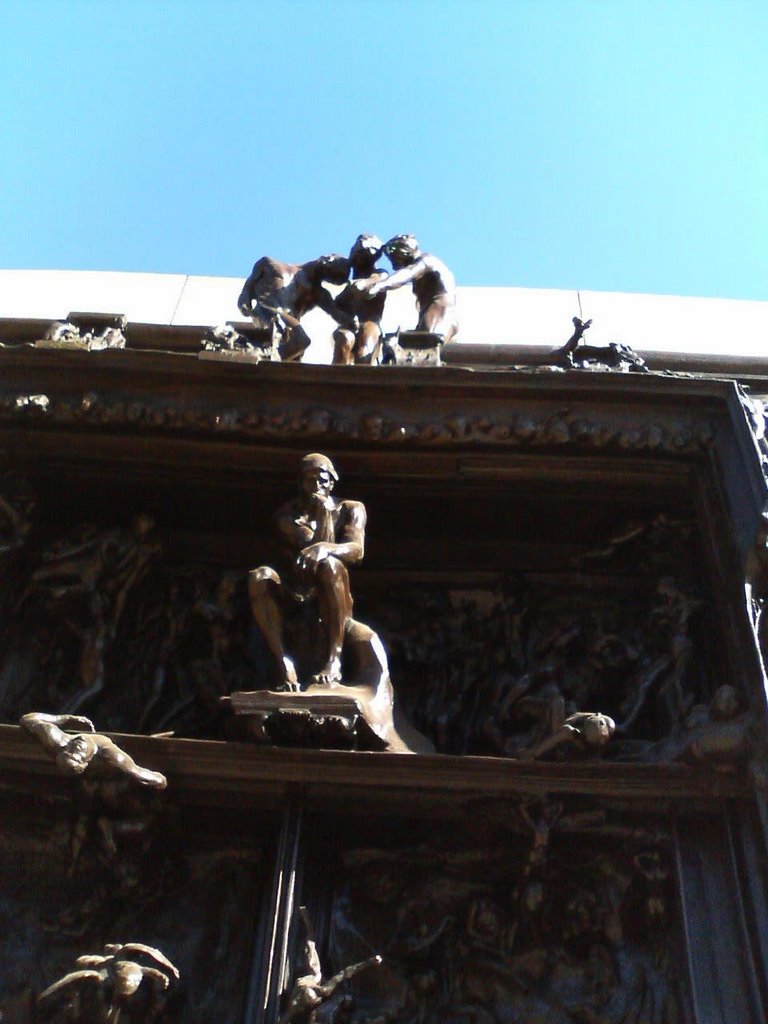
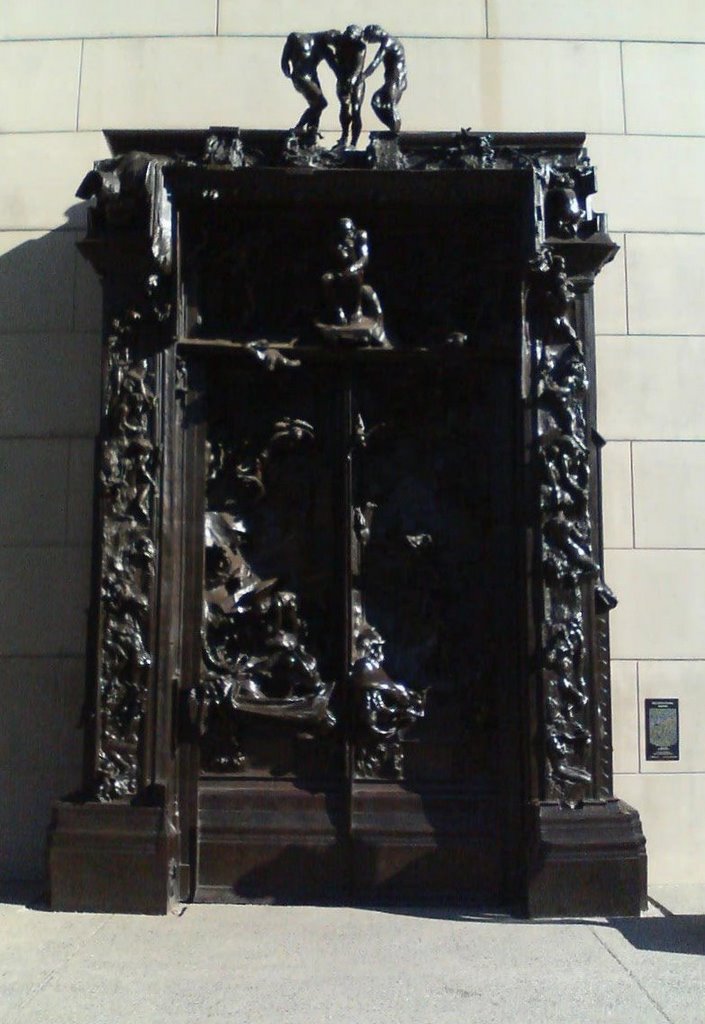
I don't know a lot about sculpture, but in my humble opinion, Rodin's "The Gates of Hell" is the greatest sculpture in the history of the Universe. Stanford has dozens (hundreds?) of Rodin sculptures (including early maquettes of "The Burghers of Calais"), both inside and outside the Cantor Center for the Visual Arts, as well as scattered around campus. The museum is well worth a visit if you have the chance; it's open late on Thursdays and admission is free, so you really don't have an excuse not to go. The museum is medium-sized, and sort of eclectic, but contains a number of powerful pieces.
Wednesday, October 18, 2006
Analog Computing Papers
Three I've run across, but not fully digested yet:
The Turan paper requires an IEEE Digital Library subscription to get, the others are available free on the web if you look.
@article{vergis1986cac,
  title={The Complexity of Analog Computation},
  author={Vergis, A. and Steiglitz, K. and Dickinson, B.},
  journal={Mathematics \& Computers in Simulation},
  volume={28},
  pages={91--113},
  year={1986},
  comment = {Claims a digital computer can efficiently simulate an
                  analog one, and an analog one can't solve NP
                  problems if a digital one can't.}
}

@article{turan1994cbf,
  title={{On the computation of Boolean functions by analog circuits ofbounded fan-in}},
  author={Turan, G. and Vatan, F.},
  journal={Foundations of Computer Science, 1994 Proceedings., 35th Annual Symposium on},
  pages={553--564},
  year={1994},
  comment = {Haven't read yet...}
}


@article{maass1998ean,
  title={{On the effect of analog noise in discrete-time analog computations}},
  author={Maass, W. and Orponen, P.},
  journal={Neural Computation},
  volume={10},
  number={5},
  pages={1071--1095},
  year={1998},
  publisher={MIT Press Cambridge, MA, USA}
}
The Turan paper requires an IEEE Digital Library subscription to get, the others are available free on the web if you look.
Sunday, October 15, 2006
Have We Found Our Architect?
If we were to stay here for a long time, we would want to find an old house and renovate it -- the older, the better. In the last few weeks, the Daily Yomiuri's regular "Cultural Inroads" column has featured two foreign architects who live here and work on preserving traditional Japanese homes, updated for modern use.
This week's is about Karl Bengs, a German architect who lives in Tokamachi, Niigata-ken. His 180-year-old thatched-roof farmhouse now has pink walls, which I could probably do without, but looks fantastic inside. (This column is apparently not on the DY website yet.)
A few weeks ago, the column was about Geoffrey Moussas, an American and an alumnus of the MIT-Japan program who lives in a machiya in Kyoto that he reconstructed over a period of several years. Moussas is also a part-time lecturer at Kyoto University.
The number one thing I would want in remodeling an old house is the ability to keep a house dry -- I'm tired of finding kabi (mildew) on everything, including my shoes. I would want the house to be well-insulated on general principle, but I'm actually more or less okay with not every room in the house being heated to exactly the same temperature, as Americans are accustomed to. A decent kitchen (rare in Japan even in recent houses), a nice bath, and a Western-style toilet with a heated seat, and we're almost there. I want a small, well-lit Japanese-style room with lots of bookcases for an office (small enough that I'm forced to not clutter it up). The house has to have at least one tatami-mat room. And if it's on a lot big enough to have a small garden, I love Japanese-style gates and garden walls.
Anything else? Hmm, can I get it within bicycling distance of a nice shotengai (shopping district) with some local, historical color (like, say, Kawagoe, where we went to a fantastic festival today that I'll write about sometime), a nice beach, a go club, and the office, and I'm in paradise. Well, of course, except for missing my family and friends, most of whom live on a different continent...
This week's is about Karl Bengs, a German architect who lives in Tokamachi, Niigata-ken. His 180-year-old thatched-roof farmhouse now has pink walls, which I could probably do without, but looks fantastic inside. (This column is apparently not on the DY website yet.)
A few weeks ago, the column was about Geoffrey Moussas, an American and an alumnus of the MIT-Japan program who lives in a machiya in Kyoto that he reconstructed over a period of several years. Moussas is also a part-time lecturer at Kyoto University.
The number one thing I would want in remodeling an old house is the ability to keep a house dry -- I'm tired of finding kabi (mildew) on everything, including my shoes. I would want the house to be well-insulated on general principle, but I'm actually more or less okay with not every room in the house being heated to exactly the same temperature, as Americans are accustomed to. A decent kitchen (rare in Japan even in recent houses), a nice bath, and a Western-style toilet with a heated seat, and we're almost there. I want a small, well-lit Japanese-style room with lots of bookcases for an office (small enough that I'm forced to not clutter it up). The house has to have at least one tatami-mat room. And if it's on a lot big enough to have a small garden, I love Japanese-style gates and garden walls.
Anything else? Hmm, can I get it within bicycling distance of a nice shotengai (shopping district) with some local, historical color (like, say, Kawagoe, where we went to a fantastic festival today that I'll write about sometime), a nice beach, a go club, and the office, and I'm in paradise. Well, of course, except for missing my family and friends, most of whom live on a different continent...
Friday, October 13, 2006
QKD Over WDM
Some researchers in China have just posted a paper on the arXiv, covering their implementation of a four-node quantum key distribution network, with a wave division multiplexing router in the middle.
Looks like interesting work, I'm looking forward to reading it in detail...
Looks like interesting work, I'm looking forward to reading it in detail...
Thursday, October 12, 2006
Kashiwa Joban Art Line
November sees the arrival of the Kashiwa Joban Art Line, a month-long arts and music festival. Looks like there will be performance art, music, museum exhibits, and maybe some participatory things. The Japanese-only website doesn't seem to have an easy-to-read calendar, but all the info is presumably there...
Wednesday, October 11, 2006
Petabytes of Personal Data
A couple of days ago, I posted a note about Microsoft having 5.5 petabytes of crash dumps of the Vista release candidate, collected presumably from all around the world from members of their beta test program. If each crash dump is a gigabyte, that's 5.5 million individual crash dumps.
My first reaction, as an engineer, was to be impressed and a little envious. Even as we near a terabyte per spindle, building a multi-petabyte archive, collected over the Internet in half a year or so, and processing it is quite an accomplishment. It's an incredible engineering resource, and it must be fascinating to write tools that accelerate debugging by leaping from dump to dump, looking for data that will confirm or disprove a hypothesis about a particular problem. Certainly a problem related to a specific hardware configuration must stick out like a sore thumb.
My second thought, as a smug Linux user, was that it would take a really long time to get 5.5 million crashes, even if everybody in the world switched tomorrow.
Then this evening it occurred to me that Microsoft now has the memory contents of millions of people's PCs. I wonder what's in there? Bank account info? IM from a congressman? Crypto keys? It seems likely that Intel and Oracle have extensive beta test programs; perhaps part or all of a chip design or database product strategy?
You don't have to be a conspiracy theorist, or even loathe Bill Gates, to think that any one organization collecting the memory contents of millions of computers is a questionable idea. It has to be a tempting target for hackers, ambitious Justice Department folks, or even curious Microsoft employees.
I'm sure there are people out there who are members of the beta program. Were you made aware that your memory contents would be sent to Microsoft in the event of a crash, and were you warned not to use it for sensitive work? Was there and agreement you had to assent to? I wonder if this violates any EU privacy laws... Does anybody know the technical details of what is and is not included in a crash dump? (e.g., is the screen memory dumped?)
My first reaction, as an engineer, was to be impressed and a little envious. Even as we near a terabyte per spindle, building a multi-petabyte archive, collected over the Internet in half a year or so, and processing it is quite an accomplishment. It's an incredible engineering resource, and it must be fascinating to write tools that accelerate debugging by leaping from dump to dump, looking for data that will confirm or disprove a hypothesis about a particular problem. Certainly a problem related to a specific hardware configuration must stick out like a sore thumb.
My second thought, as a smug Linux user, was that it would take a really long time to get 5.5 million crashes, even if everybody in the world switched tomorrow.
Then this evening it occurred to me that Microsoft now has the memory contents of millions of people's PCs. I wonder what's in there? Bank account info? IM from a congressman? Crypto keys? It seems likely that Intel and Oracle have extensive beta test programs; perhaps part or all of a chip design or database product strategy?
You don't have to be a conspiracy theorist, or even loathe Bill Gates, to think that any one organization collecting the memory contents of millions of computers is a questionable idea. It has to be a tempting target for hackers, ambitious Justice Department folks, or even curious Microsoft employees.
I'm sure there are people out there who are members of the beta program. Were you made aware that your memory contents would be sent to Microsoft in the event of a crash, and were you warned not to use it for sensitive work? Was there and agreement you had to assent to? I wonder if this violates any EU privacy laws... Does anybody know the technical details of what is and is not included in a crash dump? (e.g., is the screen memory dumped?)
Monday, October 09, 2006
Now That's a Lot of Crash Dumps
According to the New York Times, Microsoft has collected more than 5.5 petabytes (5.5E15 or 6.2E15, depending on whether you're doing base ten or base two byte measures) of crash dumps from Vista Beta 2. That's at least 450,000 crash dumps, if I read the article right. Nah, it's gotta be a lot more crashes than that -- I really doubt each crash dump is ten gigabytes...must be five million or more individual crashes.
Analyzing that many crash dumps must be fascinating. I wonder if there are automated things you can do in the analysis when you have that many individual cases that make a qualitative difference in your ability to find an individual bug, or if the vast majority of the dumps are uselessly redundant. Certainly it seems likely that bugs exercised by particular hardware (or even generated in particular device drivers) should stick out like a flashing red light (or blue screen), and repeatability is the first step in fixing a bug.
Analyzing that many crash dumps must be fascinating. I wonder if there are automated things you can do in the analysis when you have that many individual cases that make a qualitative difference in your ability to find an individual bug, or if the vast majority of the dumps are uselessly redundant. Certainly it seems likely that bugs exercised by particular hardware (or even generated in particular device drivers) should stick out like a flashing red light (or blue screen), and repeatability is the first step in fixing a bug.
Not a Fun Moment
North Korea has apparently tested a nuclear weapon. If I read the NY Times' description of the monitoring network right, the magnitude 4-ish tremor is near the lower bound of what's detectable, and that boundary is believed to be near 1 kiloton in yield.
It's theoretically possible to reduce the size of the tremor by building a test chamber designed to decouple the shock waves from the surrounding rock, but I haven't heard any suggestions that DPRK has done such a thing.
NHK is running an hour-long program about what is known about the test, and world reactions (especially the Japanese politicians). I wouldn't trade jobs with Prime Minister Abe, President Bush, or President Roh for anything right now.
I'm not prone to particularly bad dreams, but the news over the last few days about the buildup to the test must have gotten to me; I dreamt last night that I died in a nuclear blast. One of the worst dreams I can ever remember having.
It's theoretically possible to reduce the size of the tremor by building a test chamber designed to decouple the shock waves from the surrounding rock, but I haven't heard any suggestions that DPRK has done such a thing.
NHK is running an hour-long program about what is known about the test, and world reactions (especially the Japanese politicians). I wouldn't trade jobs with Prime Minister Abe, President Bush, or President Roh for anything right now.
I'm not prone to particularly bad dreams, but the news over the last few days about the buildup to the test must have gotten to me; I dreamt last night that I died in a nuclear blast. One of the worst dreams I can ever remember having.
Friday, October 06, 2006
Echizen Jellyfish in Wakasa Bay
Yow! (Yes, that's a diver in the background. The picture they put on the front page of today's Daily Yomiuri is actually a better picture.)
(If that picture has gone away, likely since Yomiuri's website is bad about archiving things, it's a picture of a diver in a cloud of meter-wide, brown Echizen jellyfish. It literally looks like the jellyfish scene from "Finding Nemo"; you can't see through the cloud. Apparently they were brought to the coast on the Japan Sea side by the recent typhoon.)
(If that picture has gone away, likely since Yomiuri's website is bad about archiving things, it's a picture of a diver in a cloud of meter-wide, brown Echizen jellyfish. It literally looks like the jellyfish scene from "Finding Nemo"; you can't see through the cloud. Apparently they were brought to the coast on the Japan Sea side by the recent typhoon.)
Thursday, October 05, 2006
A Really Big Piece of Pi
Akira Haraguchi has recited the first 100,000 decimal digits of pi from memory, according to today's Japan Times. Took him sixteen hours. This is impressive (or insane, depending on your point of view). I've heard of a ten-year-old who memorized the Koran, and people who have memorized the entire Bible (an astonishing feat), but those have structure. 100,000 random numbers, man. I can't even talk that long without going hoarse, and I like to talk.
Haraguchi hopes his feat will be listed in the Guinness Book of World Records. The current listing is 42,195 digits; last year Haraguchi went 83,431, but that one hasn't made the book yet.
Haraguchi hopes his feat will be listed in the Guinness Book of World Records. The current listing is 42,195 digits; last year Haraguchi went 83,431, but that one hasn't made the book yet.
Subscribe to:
Posts (Atom)