Some researchers in China have just posted a paper on the arXiv, covering their implementation of a four-node quantum key distribution network, with a wave division multiplexing router in the middle.
Looks like interesting work, I'm looking forward to reading it in detail...
Friday, October 13, 2006


Thursday, October 12, 2006
Kashiwa Joban Art Line
November sees the arrival of the Kashiwa Joban Art Line, a month-long arts and music festival. Looks like there will be performance art, music, museum exhibits, and maybe some participatory things. The Japanese-only website doesn't seem to have an easy-to-read calendar, but all the info is presumably there...
Wednesday, October 11, 2006
Petabytes of Personal Data
A couple of days ago, I posted a note about Microsoft having 5.5 petabytes of crash dumps of the Vista release candidate, collected presumably from all around the world from members of their beta test program. If each crash dump is a gigabyte, that's 5.5 million individual crash dumps.
My first reaction, as an engineer, was to be impressed and a little envious. Even as we near a terabyte per spindle, building a multi-petabyte archive, collected over the Internet in half a year or so, and processing it is quite an accomplishment. It's an incredible engineering resource, and it must be fascinating to write tools that accelerate debugging by leaping from dump to dump, looking for data that will confirm or disprove a hypothesis about a particular problem. Certainly a problem related to a specific hardware configuration must stick out like a sore thumb.
My second thought, as a smug Linux user, was that it would take a really long time to get 5.5 million crashes, even if everybody in the world switched tomorrow.
Then this evening it occurred to me that Microsoft now has the memory contents of millions of people's PCs. I wonder what's in there? Bank account info? IM from a congressman? Crypto keys? It seems likely that Intel and Oracle have extensive beta test programs; perhaps part or all of a chip design or database product strategy?
You don't have to be a conspiracy theorist, or even loathe Bill Gates, to think that any one organization collecting the memory contents of millions of computers is a questionable idea. It has to be a tempting target for hackers, ambitious Justice Department folks, or even curious Microsoft employees.
I'm sure there are people out there who are members of the beta program. Were you made aware that your memory contents would be sent to Microsoft in the event of a crash, and were you warned not to use it for sensitive work? Was there and agreement you had to assent to? I wonder if this violates any EU privacy laws... Does anybody know the technical details of what is and is not included in a crash dump? (e.g., is the screen memory dumped?)
My first reaction, as an engineer, was to be impressed and a little envious. Even as we near a terabyte per spindle, building a multi-petabyte archive, collected over the Internet in half a year or so, and processing it is quite an accomplishment. It's an incredible engineering resource, and it must be fascinating to write tools that accelerate debugging by leaping from dump to dump, looking for data that will confirm or disprove a hypothesis about a particular problem. Certainly a problem related to a specific hardware configuration must stick out like a sore thumb.
My second thought, as a smug Linux user, was that it would take a really long time to get 5.5 million crashes, even if everybody in the world switched tomorrow.
Then this evening it occurred to me that Microsoft now has the memory contents of millions of people's PCs. I wonder what's in there? Bank account info? IM from a congressman? Crypto keys? It seems likely that Intel and Oracle have extensive beta test programs; perhaps part or all of a chip design or database product strategy?
You don't have to be a conspiracy theorist, or even loathe Bill Gates, to think that any one organization collecting the memory contents of millions of computers is a questionable idea. It has to be a tempting target for hackers, ambitious Justice Department folks, or even curious Microsoft employees.
I'm sure there are people out there who are members of the beta program. Were you made aware that your memory contents would be sent to Microsoft in the event of a crash, and were you warned not to use it for sensitive work? Was there and agreement you had to assent to? I wonder if this violates any EU privacy laws... Does anybody know the technical details of what is and is not included in a crash dump? (e.g., is the screen memory dumped?)
Monday, October 09, 2006
Now That's a Lot of Crash Dumps
According to the New York Times, Microsoft has collected more than 5.5 petabytes (5.5E15 or 6.2E15, depending on whether you're doing base ten or base two byte measures) of crash dumps from Vista Beta 2. That's at least 450,000 crash dumps, if I read the article right. Nah, it's gotta be a lot more crashes than that -- I really doubt each crash dump is ten gigabytes...must be five million or more individual crashes.
Analyzing that many crash dumps must be fascinating. I wonder if there are automated things you can do in the analysis when you have that many individual cases that make a qualitative difference in your ability to find an individual bug, or if the vast majority of the dumps are uselessly redundant. Certainly it seems likely that bugs exercised by particular hardware (or even generated in particular device drivers) should stick out like a flashing red light (or blue screen), and repeatability is the first step in fixing a bug.
Analyzing that many crash dumps must be fascinating. I wonder if there are automated things you can do in the analysis when you have that many individual cases that make a qualitative difference in your ability to find an individual bug, or if the vast majority of the dumps are uselessly redundant. Certainly it seems likely that bugs exercised by particular hardware (or even generated in particular device drivers) should stick out like a flashing red light (or blue screen), and repeatability is the first step in fixing a bug.
Not a Fun Moment
North Korea has apparently tested a nuclear weapon. If I read the NY Times' description of the monitoring network right, the magnitude 4-ish tremor is near the lower bound of what's detectable, and that boundary is believed to be near 1 kiloton in yield.
It's theoretically possible to reduce the size of the tremor by building a test chamber designed to decouple the shock waves from the surrounding rock, but I haven't heard any suggestions that DPRK has done such a thing.
NHK is running an hour-long program about what is known about the test, and world reactions (especially the Japanese politicians). I wouldn't trade jobs with Prime Minister Abe, President Bush, or President Roh for anything right now.
I'm not prone to particularly bad dreams, but the news over the last few days about the buildup to the test must have gotten to me; I dreamt last night that I died in a nuclear blast. One of the worst dreams I can ever remember having.
It's theoretically possible to reduce the size of the tremor by building a test chamber designed to decouple the shock waves from the surrounding rock, but I haven't heard any suggestions that DPRK has done such a thing.
NHK is running an hour-long program about what is known about the test, and world reactions (especially the Japanese politicians). I wouldn't trade jobs with Prime Minister Abe, President Bush, or President Roh for anything right now.
I'm not prone to particularly bad dreams, but the news over the last few days about the buildup to the test must have gotten to me; I dreamt last night that I died in a nuclear blast. One of the worst dreams I can ever remember having.
Friday, October 06, 2006
Echizen Jellyfish in Wakasa Bay
Yow! (Yes, that's a diver in the background. The picture they put on the front page of today's Daily Yomiuri is actually a better picture.)
(If that picture has gone away, likely since Yomiuri's website is bad about archiving things, it's a picture of a diver in a cloud of meter-wide, brown Echizen jellyfish. It literally looks like the jellyfish scene from "Finding Nemo"; you can't see through the cloud. Apparently they were brought to the coast on the Japan Sea side by the recent typhoon.)
(If that picture has gone away, likely since Yomiuri's website is bad about archiving things, it's a picture of a diver in a cloud of meter-wide, brown Echizen jellyfish. It literally looks like the jellyfish scene from "Finding Nemo"; you can't see through the cloud. Apparently they were brought to the coast on the Japan Sea side by the recent typhoon.)
Thursday, October 05, 2006
A Really Big Piece of Pi
Akira Haraguchi has recited the first 100,000 decimal digits of pi from memory, according to today's Japan Times. Took him sixteen hours. This is impressive (or insane, depending on your point of view). I've heard of a ten-year-old who memorized the Koran, and people who have memorized the entire Bible (an astonishing feat), but those have structure. 100,000 random numbers, man. I can't even talk that long without going hoarse, and I like to talk.
Haraguchi hopes his feat will be listed in the Guinness Book of World Records. The current listing is 42,195 digits; last year Haraguchi went 83,431, but that one hasn't made the book yet.
Haraguchi hopes his feat will be listed in the Guinness Book of World Records. The current listing is 42,195 digits; last year Haraguchi went 83,431, but that one hasn't made the book yet.
Audio Bar Codes, 3D Displays
DoCoMo is advertising a new feature on some of its phones: audio bar codes. For quite a while now it has been possible to use your cell phone camera to snap a picture of a bar code and be transported to a web site with product information (including provenance of fish or produce, at least in theory; in practice it usually seems to be promotional material). Now they have a new way to send you small amounts of information, such as a URL: high-frequency sound. You're walking down the street assaulted by the usual battery of recorded touts begging you to come in and buy something, and now your keitai (cell phone) can get in on the fun, too, picking up a URL or two out of the cacophony. Of course, I'm sure they intend to see the equipment to broadcast such audio, too.
The ad I saw this in had a link to NTT's R&D website, but a quick glance there doesn't turn up anything about the audio bar codes. I did see a press release about a 3D lenticular display that tracks the position of the user to optimize the 3D-ness of the image, as well as one about a water-based fuel cell for cell phones being jointly developed with Aqua Fairy.
The ad I saw this in had a link to NTT's R&D website, but a quick glance there doesn't turn up anything about the audio bar codes. I did see a press release about a 3D lenticular display that tracks the position of the user to optimize the 3D-ness of the image, as well as one about a water-based fuel cell for cell phones being jointly developed with Aqua Fairy.
Volcanic Winter
A nice article from NASA's Science News mailing list, on recent analysis of the climate effects of Novarupta. Novarupta was the largest volcanic explosion of the 20th century, in the Aleutian Islands. Scientists are discovering that the effects of Arctic volcanoes are very different from the effects of tropical ones.
Tuesday, October 03, 2006
New Storage Research Mailing List
Garth Gibson has just announced the creation of a new storage research-related mailing list, intended for announcements of conferences, etc. This is something we've needed for a long time.
Monday, October 02, 2006
Mitsubishi Jet?
An article in today's Daily Yomiuri talks about an ongoing pre-development design project between METI and Mitsubishi Heavy Industries to design a 70-90 passenger regional jet, to be powered by Rolls Royce engines. ("Heavy" would seem to be an unfortunate word to have in the name of a plane manufacturer, but never mind.) A go/no-go decision is expected next year, and it will debut in 2012. Tens of millions of dollars have been spent already, but that's nothing compared to full-blown development and manufacture of a passenger jet. It's expected that sales would have to be 350 planes to break even, and 600 to make a decent profit.
The plane's selling point is expected to be that it will be 20% more fuel efficient than similar planes from other manufacturers, but the article doesn't say how that's to be achieved. It also says that MHI wants to work with trading houses to arrange favorable financing for export.
Japan hasn't produced a full airliner of its own since the YS-11, which ended production in 1973 after production of 182 planes. I'm looking forward to someday flying on a Honda Jet, though.
The plane's selling point is expected to be that it will be 20% more fuel efficient than similar planes from other manufacturers, but the article doesn't say how that's to be achieved. It also says that MHI wants to work with trading houses to arrange favorable financing for export.
Japan hasn't produced a full airliner of its own since the YS-11, which ended production in 1973 after production of 182 planes. I'm looking forward to someday flying on a Honda Jet, though.
Wind Powerless
An article in today's Daily Yomiuri about a single large wind turbine in Gunma-ken is very frustrating. The headline says "Wind-power station generates losses", and goes on to talk about the money they've lost, but with such an odd collection of numbers that it's hard to figure out exactly what's what.
"The facility was projected to produce 327,200 kilowatts of electricity a year," the article says. Yup, that's what it says. Not "kilowatt-hours", "kilowatts". If we assume that they meant to say kilowatt-hours, that's a year-round average production of 37.352 kilowatts. That seems modest for such a large turbine (there's a photo, it must be at least eight or ten stories high, but it's hard to tell), but the article doesn't give its size or peak output rating. Worse, the turbine generated only 274,000 "kilowatts" in its best year, fiscal 2000, and last year generated only 192,000, less than sixty percent of the planned output.
The article also gives some economic figures -- saying that the Gunma government spent 76 million yen (about three quarters of a million dollars) and the New Energy and Industrial Energy Development Organization (NEDO) kicking in 57 million yen -- but it doesn't say what those costs covered. The losses are listed at five to seven and a half million yen (forty-five to sixty-grand, give or take) a year, but it doesn't say what price was being paid per kWh, what subsidies were in place, what the operating costs are, etc. Wind power in general still requires some subsidies to be economically competitive (until the price of coal and oil go up; it may already be competitive with nuclear, once government supports are factored in). Are the losses after those? Or do they not exist here? I'm not sure.
The article also talks about the "optimum wind velocity for power generation" being 13.5 meters/second. Of course, there is no such thing as a blanket statement; the power generated continues to rise as the wind speed goes up, until the turbine itself begins to be threatened by the winds. Certainly a wind that slow wouldn't be a problem. The article does say that average speeds at the facility have been no more than 3.6 m/sec. (and the power rises with the square of the wind speed, too).
"Its disappointing performance is blamed on a miscalculation of the winds expected in the area," it says. Uh-huh. Nobody knew that at Yoshiokamachi, between Mt. Haruna and the Tonegawa River, there wouldn't be enough wind. I'll bet a little digging would turn up interesting things in the site selection process. The article does seem to say that feasibility studies at Tsumakoimura, Showamura and Harunamachi showed negative results.
Ah, I did find a couple of sites (in Japanese) with some info on the project. It's a 300kw peak output turbine, built by Mitsubishi, and the blades automatically feather in winds above 24m/sec. I don't see at what speed the 300kw is output. One of the articles says this is enough power for 90 regular homes.
This one isn't it, but coming home on the shinkansen the other day, we saw a similar turbine deep in a valley somewhere in Fukushima-ken. It struck us as unlikely that such a location has strong enough winds regularly to make wind power attractive. I've also seen several near the port in Naoetsu, I believe, where it seems to make more sense. Japan as a whole is gradually catching on to wind power, and it's not uncommon to see new houses with small solar arrays on top, too. Maybe there's hope yet.
"The facility was projected to produce 327,200 kilowatts of electricity a year," the article says. Yup, that's what it says. Not "kilowatt-hours", "kilowatts". If we assume that they meant to say kilowatt-hours, that's a year-round average production of 37.352 kilowatts. That seems modest for such a large turbine (there's a photo, it must be at least eight or ten stories high, but it's hard to tell), but the article doesn't give its size or peak output rating. Worse, the turbine generated only 274,000 "kilowatts" in its best year, fiscal 2000, and last year generated only 192,000, less than sixty percent of the planned output.
The article also gives some economic figures -- saying that the Gunma government spent 76 million yen (about three quarters of a million dollars) and the New Energy and Industrial Energy Development Organization (NEDO) kicking in 57 million yen -- but it doesn't say what those costs covered. The losses are listed at five to seven and a half million yen (forty-five to sixty-grand, give or take) a year, but it doesn't say what price was being paid per kWh, what subsidies were in place, what the operating costs are, etc. Wind power in general still requires some subsidies to be economically competitive (until the price of coal and oil go up; it may already be competitive with nuclear, once government supports are factored in). Are the losses after those? Or do they not exist here? I'm not sure.
The article also talks about the "optimum wind velocity for power generation" being 13.5 meters/second. Of course, there is no such thing as a blanket statement; the power generated continues to rise as the wind speed goes up, until the turbine itself begins to be threatened by the winds. Certainly a wind that slow wouldn't be a problem. The article does say that average speeds at the facility have been no more than 3.6 m/sec. (and the power rises with the square of the wind speed, too).
"Its disappointing performance is blamed on a miscalculation of the winds expected in the area," it says. Uh-huh. Nobody knew that at Yoshiokamachi, between Mt. Haruna and the Tonegawa River, there wouldn't be enough wind. I'll bet a little digging would turn up interesting things in the site selection process. The article does seem to say that feasibility studies at Tsumakoimura, Showamura and Harunamachi showed negative results.
Ah, I did find a couple of sites (in Japanese) with some info on the project. It's a 300kw peak output turbine, built by Mitsubishi, and the blades automatically feather in winds above 24m/sec. I don't see at what speed the 300kw is output. One of the articles says this is enough power for 90 regular homes.
This one isn't it, but coming home on the shinkansen the other day, we saw a similar turbine deep in a valley somewhere in Fukushima-ken. It struck us as unlikely that such a location has strong enough winds regularly to make wind power attractive. I've also seen several near the port in Naoetsu, I believe, where it seems to make more sense. Japan as a whole is gradually catching on to wind power, and it's not uncommon to see new houses with small solar arrays on top, too. Maybe there's hope yet.
Steganographic Squid
This is wonderful: squid communicating via polarized light in a "hidden" channel. The commenter who said that they can do QKD may be thinking of a different kind of squid :-).
Saturday, September 30, 2006
Graduation


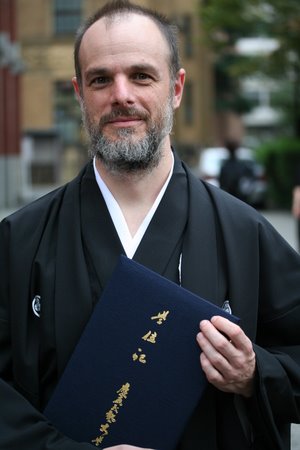
Keio will be 150 years old in 2008, and the graduate school's first entering class was 100 years ago in February. There have been 300,000 Keio University graduates over that time, including two of the last four prime ministers of Japan, two astronauts, the presidents, chairmen, and publishers of several of the major newspapers and television networks, and the architect of the upcoming remodeling of MOMA in New York. (And probably more than half of Keio's own faculty.)
And me, the 2,630th Ph.D. in Engineering, apparently numbered since the last major reorganization of the schools in the mid-90s.
I owe more than I can say to many, many people. The foreword to my thesis tries to say :-). Thanks for all of your support and love.
More pictures on Mayumi's blog.
Thursday, September 28, 2006
Robot Skin
Robot skin from the Maeno Lab at Keio University and Kao Corporation. I wonder if it's warm?
Wednesday, September 27, 2006
David R. Cheriton School of Computer Science
I know the name David Cheriton for his seminal work in distributed systems in the 1980s, including the V system he led the development of as a Stanford professor. (I've always been particularly fond of the "triangle RPCs" in VMTP, allowing the reply to an RPC to arrive from a node different from the one that the request was originally sent to. We gave serious consideration to using that model in the Netstation work in the mid-90s.) Others no doubt know his name as a venture capitalist; he made a gazillion (a google?) bucks backing a little startup named Google almost a decade ago.
Now his name will be known to many because of his gift of $25 million to the University of Waterloo, where the CS department now becomes the David R. Cheriton School of Computer Science.
Congratulations to UW, and thanks, David, for giving back! Without strong universities, we have no future.
Now his name will be known to many because of his gift of $25 million to the University of Waterloo, where the CS department now becomes the David R. Cheriton School of Computer Science.
Congratulations to UW, and thanks, David, for giving back! Without strong universities, we have no future.
Monday, September 25, 2006
NTT IP Phone Outage
An article in Saturday's Daily Yomiuri, which apparently isn't online, discusses outages in NTT East's systems on September 19 & 20. About 800,000 lines of its "Hikari" (light) service were affected. The principle problem seems to have been in relay servers that move calls between the IP network and the POTS (plain old telephone service) phones. Apparently they received 35,000 complaints about the problem.
Monday was a holiday, and on Tuesday morning traffic was three times normal, according to NTT. A server handling calls coming in from the POTS network became overloaded, and traffic was apparently shifted to another server in Miyagi Prefecture, which was designed to handle 200,000 calls but was given 260,000 calls. Controls had to be activated to limit traffic. The article doesn't say what those "controls" are, but presumably callers get a busy signal or perhaps a message, instead of being connected.
"To prevent the trouble recurring, NTT East on Thursday limited traffic between Hikari telephones and fixed-line phones and between Hikari phones and cell phones by 50 percent." Again, not a lot of details on how this accomplished.
NTT East says about 60 percent of new subscribers to its B-FLETS fiber optic Internet service also subscribe to its IP phone service. There are about 12 million IP phones in the country as of June, up 30 percent from a year ago.
There don't seem to have been any problems between Hikari phones and other Hikari phones. I'm curious about IP phones from other providers besides NTT East; if I had to guess, I would guess that the peering there is done on the POTS network rather than direct IP telephony connections.
The article includes various expressions of regret and government suggestions of more regulations, but no specific timetable for fixing the underlying problem.
Monday was a holiday, and on Tuesday morning traffic was three times normal, according to NTT. A server handling calls coming in from the POTS network became overloaded, and traffic was apparently shifted to another server in Miyagi Prefecture, which was designed to handle 200,000 calls but was given 260,000 calls. Controls had to be activated to limit traffic. The article doesn't say what those "controls" are, but presumably callers get a busy signal or perhaps a message, instead of being connected.
"To prevent the trouble recurring, NTT East on Thursday limited traffic between Hikari telephones and fixed-line phones and between Hikari phones and cell phones by 50 percent." Again, not a lot of details on how this accomplished.
NTT East says about 60 percent of new subscribers to its B-FLETS fiber optic Internet service also subscribe to its IP phone service. There are about 12 million IP phones in the country as of June, up 30 percent from a year ago.
There don't seem to have been any problems between Hikari phones and other Hikari phones. I'm curious about IP phones from other providers besides NTT East; if I had to guess, I would guess that the peering there is done on the POTS network rather than direct IP telephony connections.
The article includes various expressions of regret and government suggestions of more regulations, but no specific timetable for fixing the underlying problem.
Digitally Unable to Repeat the Past
An article in the L.A. TImes by Charles Piller begins,
"Carter G. Walker remembers the day her memories vanished.
"After sending an e-mail to her aunt, the Montana freelance writer stepped away from the computer to make a grilled-cheese sandwich. She returned a few minutes later to a black screen. Data recovery experts did what they could, but the hard drive was beyond saving — as were the precious moments Walker had entrusted to it."
The article goes on to lament the loss of digital data even under the government's care, quoting archivists from the National Archives and citing examples such as priceless lost NASA data, and says that W's presidency is likely to leave a less complete legacy than Lincoln's did.
In the mass storage industry, we have known about this problem for a long time, especially the migration problem as different forms of digital media become obsolete. One key problem is more than just hardware is required to read modern media -- complex software is required, too. Even if you could somehow take apart a DVD player a hundred years from now and recreate the hardware, without the firmware, you're out of luck.
The IEEE Technical Committee on Mass Storage Systems (MSSTC), the executive committee of which I'm a member of, sponsors a series of conferences, at which the archival problem is often addressed. Bob Coyne of IBM and Reagan Moore of SDSC are particularly active in this area, especially in being able to find the particular data you're looking for, which starts with tagging it with the right metadata when it's created.
At one conference, we had a presentation from some people interested in creating archival storage in the sense that the Rosetta Stone is archival storage. It was a stainless steel platter with microscopic pits for bits, like a permanent pressing master for a large CD. But it also included a picture visible to the naked eye explaining how to build a reader for the data. Good idea.
"'If we don't solve the problem, our time will not become part of the past,' said Kenneth Thibodaux, who directs electronic records preservation for the National Archives. 'It will largely vanish.'"
Indeed.
"Carter G. Walker remembers the day her memories vanished.
"After sending an e-mail to her aunt, the Montana freelance writer stepped away from the computer to make a grilled-cheese sandwich. She returned a few minutes later to a black screen. Data recovery experts did what they could, but the hard drive was beyond saving — as were the precious moments Walker had entrusted to it."
The article goes on to lament the loss of digital data even under the government's care, quoting archivists from the National Archives and citing examples such as priceless lost NASA data, and says that W's presidency is likely to leave a less complete legacy than Lincoln's did.
In the mass storage industry, we have known about this problem for a long time, especially the migration problem as different forms of digital media become obsolete. One key problem is more than just hardware is required to read modern media -- complex software is required, too. Even if you could somehow take apart a DVD player a hundred years from now and recreate the hardware, without the firmware, you're out of luck.
The IEEE Technical Committee on Mass Storage Systems (MSSTC), the executive committee of which I'm a member of, sponsors a series of conferences, at which the archival problem is often addressed. Bob Coyne of IBM and Reagan Moore of SDSC are particularly active in this area, especially in being able to find the particular data you're looking for, which starts with tagging it with the right metadata when it's created.
At one conference, we had a presentation from some people interested in creating archival storage in the sense that the Rosetta Stone is archival storage. It was a stainless steel platter with microscopic pits for bits, like a permanent pressing master for a large CD. But it also included a picture visible to the naked eye explaining how to build a reader for the data. Good idea.
"'If we don't solve the problem, our time will not become part of the past,' said Kenneth Thibodaux, who directs electronic records preservation for the National Archives. 'It will largely vanish.'"
Indeed.
Saturday, September 23, 2006
Tracking the Gaijin
The Daily Yomiuri reports today that the Japanese government is planning on increasing its tracking of foreigners (gaijin). Apparently different government ministries currently perform different levels and styles of tracking (no surprise), and the data doesn't agree (again, no surprise).
The Health, Labor, and Welfare Ministry (Kosei-rodo-sho) says companies have reported to it that they employee about 340,000 foreigners. But the Justice Ministry (Homu-sho), which is probably in charge of visas, says there about 2.01 million foreigners here, of whom it estimates about 800,000 are working, either legally or illegally. That's quite a discrepancy!
Apparently companies aren't required to report on the status of their employees, and reports are only accepted from firms with more than 50 employees.
Getting a work visa here is not fraught with the stress and feeling of fear that some faceless bureaucrat will make an arbitrary decision that ruins your life, as dealing with the INS in the U.S. is. However, it is a lot of paperwork, tedious and time-consuming. Among other things, they want to see your original college diploma. Not a certified transcript from the university listing your graduation date, they want to see your actual sheepskin. The end result is a stamp in your passport (these days, including a 2D barcode that apparently contains either binary or encrypted data) and a gaikokujin torokusho, your alien registration card, which you have to carry at all times. And, of course, you have to register with the local government when you move. (This is true for Japanese, too; they are surprised when they find out that Americans don't have to register when you move inside the U.S.)
And the end result of this bureaucracy is that the government doesn't know to within a factor of two how many foreigners are actually working in this country? The biggest change proposed seems to be requiring companies to report the names of their foreign employees to the government.
The Health, Labor, and Welfare Ministry (Kosei-rodo-sho) says companies have reported to it that they employee about 340,000 foreigners. But the Justice Ministry (Homu-sho), which is probably in charge of visas, says there about 2.01 million foreigners here, of whom it estimates about 800,000 are working, either legally or illegally. That's quite a discrepancy!
Apparently companies aren't required to report on the status of their employees, and reports are only accepted from firms with more than 50 employees.
Getting a work visa here is not fraught with the stress and feeling of fear that some faceless bureaucrat will make an arbitrary decision that ruins your life, as dealing with the INS in the U.S. is. However, it is a lot of paperwork, tedious and time-consuming. Among other things, they want to see your original college diploma. Not a certified transcript from the university listing your graduation date, they want to see your actual sheepskin. The end result is a stamp in your passport (these days, including a 2D barcode that apparently contains either binary or encrypted data) and a gaikokujin torokusho, your alien registration card, which you have to carry at all times. And, of course, you have to register with the local government when you move. (This is true for Japanese, too; they are surprised when they find out that Americans don't have to register when you move inside the U.S.)
And the end result of this bureaucracy is that the government doesn't know to within a factor of two how many foreigners are actually working in this country? The biggest change proposed seems to be requiring companies to report the names of their foreign employees to the government.
Friday, September 22, 2006
Ranking Keio
The Sept. 27 issue of the Japanese edition of Newsweek is out, and features a list of the top 100 universities in the world. I'll post a longer discussion of the list sometime (as soon as I figure out how to criticize it without annoying people :-), but I'm disappointed to report that Keio University, my alma mater for my Ph.D., didn't make the list. Five other Japanese universities (U. Tokyo, Kyoto U., Osaka U., Nagoya U., and Tohoku U.) did.
There are a lot of reasons why it's difficult to rank Japanese universities using an America-centric rating system, but ranking the universities is a big sport here, too, and in most of those lists, Keio comes in third, after Todai (Tokyo) and Kyodai (Kyoto), which by general agreement usually do come in number one and two. Waseda University, Japan's other most famous private university, also usually ranks near the top.
Wikipedia's article on Keio has a short list of some of the prominent Keio alumni. Probably the most famous at the moment is Junichiro Koizumi, the outgoing prime minister (2001-2005), but he's not the only prominent politician. Ryutaro Hashimoto, who was prime minister 1996-1998, recently passed away. Dozens of other alumni have been cabinet members and governors in the post-war period.
Two astronauts, Chiaki Mukai, who has already been into space, and Akihiko Hoshide, who is working on it, are grads. In business, the owners of the Yomiuri and Asahi newspapers, the president of Nippon TV, president of TBS, chairman of All Nippon Airways, and more are grads. Yoshio Taniguchi, architect of the redesigned MoMA in New York, is a Keio (and Harvard) grad, with a B.S. in M.E. (His father, Yoshiro Taniguchi, was also an architect; I'm not sure if he was a Keio grad or not.) Ted Nelson, who coined the term hypertext in 1963, was awarded a Ph.D. in 2002.
Enough rambling. Suffice it to say that Keio is one of Japan's best and most important universities, and, in my opinion, should have made Newsweek's list.
There are a lot of reasons why it's difficult to rank Japanese universities using an America-centric rating system, but ranking the universities is a big sport here, too, and in most of those lists, Keio comes in third, after Todai (Tokyo) and Kyodai (Kyoto), which by general agreement usually do come in number one and two. Waseda University, Japan's other most famous private university, also usually ranks near the top.
Wikipedia's article on Keio has a short list of some of the prominent Keio alumni. Probably the most famous at the moment is Junichiro Koizumi, the outgoing prime minister (2001-2005), but he's not the only prominent politician. Ryutaro Hashimoto, who was prime minister 1996-1998, recently passed away. Dozens of other alumni have been cabinet members and governors in the post-war period.
Two astronauts, Chiaki Mukai, who has already been into space, and Akihiko Hoshide, who is working on it, are grads. In business, the owners of the Yomiuri and Asahi newspapers, the president of Nippon TV, president of TBS, chairman of All Nippon Airways, and more are grads. Yoshio Taniguchi, architect of the redesigned MoMA in New York, is a Keio (and Harvard) grad, with a B.S. in M.E. (His father, Yoshiro Taniguchi, was also an architect; I'm not sure if he was a Keio grad or not.) Ted Nelson, who coined the term hypertext in 1963, was awarded a Ph.D. in 2002.
Enough rambling. Suffice it to say that Keio is one of Japan's best and most important universities, and, in my opinion, should have made Newsweek's list.
Thursday, September 21, 2006
Ten Ways to Destroy the Earth
I'm not sure if I'd really call them the top ten ways, but some of them aren't bad. A quibble with the gray goo variant, though -- in relatively short order you end up with a large sphere of von Neumann machines (where did he get that name?), and expansion slows to a polynomial limited by the speed of the machines themselves, rather than staying exponential.
Wednesday, September 20, 2006
ERATO-SORST QCI Project, and Hayashi-san's Book
The ERATO-SORST QCI (Quantum Computation and Information) project run by Professor Hiroshi Imai of the University of Tokyo, has revamped their web pages to be a lot more accessible. Their list of journal pubs is still in progress (it's long, I've seen it; 75ish papers). The web site includes a useful list of quantum conferences.
The site also prominently mentions a new book by Hayashi-san, Quantum Information Theory: An Introduction, recently published by Springer. I have seen a short book of his in Japanese, but haven't seen this new one in English. Worth checking out.
The site also prominently mentions a new book by Hayashi-san, Quantum Information Theory: An Introduction, recently published by Springer. I have seen a short book of his in Japanese, but haven't seen this new one in English. Worth checking out.
Tuesday, September 19, 2006
Quantum Chaos: Two Papers
Two new papers in Phys Rev E address quantum (computing) chaos for very different purposes. I haven't yet had time to digest them thoroughly, but thought others might be interested.
The first one (PRE 74, 035203) analyzes Shor's algorithm and is heavy on the math and jargon, but if I understand it right, implies that the states necessary for Shor demonstrate chaos, i.e. are sensitive to small perturbations. This would, I think, be bad news for Shor. They simplify the algorithm to the point that they treat the modular exponentiation as a single step, and the QFT as a single step, which of course is not very representative of the way the algorithm will really be run (I believe), but that doesn't mean that their analysis is necessarily off base. I've discussed this issue of real-world perturbations and Shor's alogithm with a number of people in the last couple of years, and I'm not completely satisfied with the answer yet. Probably I'm just being dense, or my intuition is off somewhere, but in my opinion, there is still work to do here, and this paper comes at the problem from a different angle.
The second paper (PRE 74, 026208) analyzes the all-silicon NMR quantum computer being developed by the Yamamoto group at Stanford and the Itoh group at Keio (see PRL 89, 017901 and a whole string of papers both earlier and later). The paper appears to be good news, saying that the strong magnetic fields help suppress chaos. (Disclaimer: I work with the Keio and Stanford people.)
The first one (PRE 74, 035203) analyzes Shor's algorithm and is heavy on the math and jargon, but if I understand it right, implies that the states necessary for Shor demonstrate chaos, i.e. are sensitive to small perturbations. This would, I think, be bad news for Shor. They simplify the algorithm to the point that they treat the modular exponentiation as a single step, and the QFT as a single step, which of course is not very representative of the way the algorithm will really be run (I believe), but that doesn't mean that their analysis is necessarily off base. I've discussed this issue of real-world perturbations and Shor's alogithm with a number of people in the last couple of years, and I'm not completely satisfied with the answer yet. Probably I'm just being dense, or my intuition is off somewhere, but in my opinion, there is still work to do here, and this paper comes at the problem from a different angle.
The second paper (PRE 74, 026208) analyzes the all-silicon NMR quantum computer being developed by the Yamamoto group at Stanford and the Itoh group at Keio (see PRL 89, 017901 and a whole string of papers both earlier and later). The paper appears to be good news, saying that the strong magnetic fields help suppress chaos. (Disclaimer: I work with the Keio and Stanford people.)
Monday, September 18, 2006
Disturbingly Bad Japanese TV
I'm posting this not because I think it's funny, but because I don't. I hate these "torment the guest" shows. American reality TV has nothing on Japan, where abusing the guests has a long tradition. I've seen shows where guests attempted to stay in a large acrylic tub full of scalding hot water in exchange for the right to promote their restaurant or hair salon, shows where guests drank large quantities of beer and then stood around trying not to be the first guy to break ranks and run for the bathroom, and more. And now this. Say a tongue twister or get, well, punished.
Sunday, September 17, 2006
Telecommuting for Soumu-sho
The Internal Affairs and Communications Ministry (Soumu-sho) on Friday initiated a telecommuting program, the first in the government. They hope to allow up to 20 percent of all workers to telecommute by 2010.
The Daily Yomiuri article (which is apparently not online -- they don't put all content online, and are terrible about archiving it) says that "[w]orkers will be required to use designated computers that cannot record data in their memories, so that they will not be able to remove classified information from the ministry's premises. The ministry also said it would encode all communications." I'm not sure if this is vague because the original in Japanese was vague, or if the translation is bad, but I'd like to know a lot more before I agreed that they had covered all of the bases, especially given all of the incidents in the last couple of years of laptops with government information on them being lost or stolen.
Telecommuters will be allowed to work at home up to three days a week. They have to check in and out with their supervisor via phone or email when they start and end work, and go to and return from lunch.
The Daily Yomiuri article (which is apparently not online -- they don't put all content online, and are terrible about archiving it) says that "[w]orkers will be required to use designated computers that cannot record data in their memories, so that they will not be able to remove classified information from the ministry's premises. The ministry also said it would encode all communications." I'm not sure if this is vague because the original in Japanese was vague, or if the translation is bad, but I'd like to know a lot more before I agreed that they had covered all of the bases, especially given all of the incidents in the last couple of years of laptops with government information on them being lost or stolen.
Telecommuters will be allowed to work at home up to three days a week. They have to check in and out with their supervisor via phone or email when they start and end work, and go to and return from lunch.
Security at Narita
Speaking of security, is there really a gaping hole at Narita Airport, here in Japan? When you go to check in for an international flight, the first thing that happens is that your luggage is x-rayed. Then they give it back to you -- and you haven't been scanned yet. Yeah, they put a sticker on it, but who's that going to stop? Then you stand in line for half an hour, give them your luggage again, and it disappears into the bowels of the system somewhere. There would be plenty of time to slip something into your suitcase while waiting; in fact, I've done it (just a book and umbrella I decided I didn't want to carry to the plane). I have asked, and been told that bags are not x-rayed again once they are taken from you; I don't know for certain if that is true or not.
More Random Japan News
(I'm just in that kind of mood.)
Thanks to Schneier's Friday Squid Blogging, squid ice cream (Ika Aisu), squid ink ice cream, and other kinds, including abalone (awabi). Reminds me of the time one of the Iron Chefs tried to make mackerel ice cream (which was not a big success).
Those Japanese centenarians I mentioned yesterday? 24,245 are women, and only 4,150 are men.
The Japanese justice system incarcerates 70,737 people, about 1 in 2,000 residents. In the U.S., the equivalent rate is about 1:140, with 2.2 million people locked up.
Prime minister-designate Shinzo Abe said he has no plans to reform the Imperial House Law and allow Princess Aiko to ascend the throne.
Japan recently launched a spy satellite, and it's creating more discussion about whether the laws restricting Japan's military need to be revised.
Thanks to Schneier's Friday Squid Blogging, squid ice cream (Ika Aisu), squid ink ice cream, and other kinds, including abalone (awabi). Reminds me of the time one of the Iron Chefs tried to make mackerel ice cream (which was not a big success).
Those Japanese centenarians I mentioned yesterday? 24,245 are women, and only 4,150 are men.
The Japanese justice system incarcerates 70,737 people, about 1 in 2,000 residents. In the U.S., the equivalent rate is about 1:140, with 2.2 million people locked up.
Prime minister-designate Shinzo Abe said he has no plans to reform the Imperial House Law and allow Princess Aiko to ascend the throne.
Japan recently launched a spy satellite, and it's creating more discussion about whether the laws restricting Japan's military need to be revised.
Online Social Groups in Japan
Social networking services (SNS) have been growing here in Japan, and have been in the news lately because the biggest, Mixi, just went public on the stock market. According to an article in the Daily Yomiuri, there are 7.16 million people using the services as of the end of March this year, up 550% from the year before. Mixi alone has more than 5.7 million users.
In these networks -- like LinkedIn, or Tribe.net -- you have to be introduced by an existing member. According to a TV show I was watching in a doctor's waiting room yesterday, this makes people feel safer. It certainly doesn't mean it's impossible to set up a scam; just find someone in the group and offer them fifty bucks to endorse you. But it should help a little in that respect. More important, to me, is that it should make it easier to build a real community of introduced acquaintances.
In these networks -- like LinkedIn, or Tribe.net -- you have to be introduced by an existing member. According to a TV show I was watching in a doctor's waiting room yesterday, this makes people feel safer. It certainly doesn't mean it's impossible to set up a scam; just find someone in the group and offer them fifty bucks to endorse you. But it should help a little in that respect. More important, to me, is that it should make it easier to build a real community of introduced acquaintances.
Saturday, September 16, 2006
Random Japan News
As long as I'm riffing on Japan, Shoko Asahara, the founder of Aum Shinri Kyo, which perpetrated the sarin gas attacks in the Tokyo subway system in 1995, has been declared sane and exhausted his appeals, and will be executed. Inpex, which is tied to the Japanese government, is still in negotiations to develop an Iranian oil field, but the current nuclear crisis is muddying the waters. Amid rising privacy concerns, the government will scrap its public list of the 100 oldest people in the country, although there is also news that there are now 28,395 people over the age of 100 in the country, up more than 2,800 from a year ago.
As in America, so in Japan; critics lament the dearth of real news on TV, in favor of infotainment. The critic mentions one piece of actual information from a show about Japan's rising gap between the top and bottom of the economic ladder: in the 1980s, the top quintile made ten times what the bottom quintile did; by 2000, the gap was 168 times. Personally, I'm a little suspicious; perhaps the stats have been revised. If the bottom quintile makes an average of even just half a million yen (nearly five thousand dollars), that would mean the top quintile averaged about three quarters of a million dollars a year. Japan has fewer people making Internet bubble-like insane stock options, and I don't think the high-end top percent or two is enough to pull up the rest of the top quintile that high. Hmm, perhaps there's a missing decimal point, and it's supposed to be 16.8 times? Maybe the bottom quintile is unemployed and has a near-zero income, and those people didn't used to be included in the stats? I'll have to investigate...
Shinzo Abe isset to become the next prime minister with limited input from the people (as an American, I find parliamentary politics strange, and Japan has its own unique brand). Oh, and the fall sumo tournament is wide open, heading into the first weekend, with all of the top wrestlers with at least one loss.
As in America, so in Japan; critics lament the dearth of real news on TV, in favor of infotainment. The critic mentions one piece of actual information from a show about Japan's rising gap between the top and bottom of the economic ladder: in the 1980s, the top quintile made ten times what the bottom quintile did; by 2000, the gap was 168 times. Personally, I'm a little suspicious; perhaps the stats have been revised. If the bottom quintile makes an average of even just half a million yen (nearly five thousand dollars), that would mean the top quintile averaged about three quarters of a million dollars a year. Japan has fewer people making Internet bubble-like insane stock options, and I don't think the high-end top percent or two is enough to pull up the rest of the top quintile that high. Hmm, perhaps there's a missing decimal point, and it's supposed to be 16.8 times? Maybe the bottom quintile is unemployed and has a near-zero income, and those people didn't used to be included in the stats? I'll have to investigate...
Shinzo Abe isset to become the next prime minister with limited input from the people (as an American, I find parliamentary politics strange, and Japan has its own unique brand). Oh, and the fall sumo tournament is wide open, heading into the first weekend, with all of the top wrestlers with at least one loss.
Carter and North Korea
I mostly keep politics out of this blog (there are plenty of places you can pick that up if you're looking, so it would be little more than me venting my own frustrations), but this one deserves wider attention than it is likely to get.
Today's Daily Yomiuri has a review of A Moment of Crisis: Jimmy Carter, The Power of a Peacemaker, and North Korea's Nuclear Ambitions, by Marion Creekmore Jr. The review is by Kenneth Quinones, author of The Complete Idiot's Guide to Understanding North Korea, and a professor at Akita International University in northern Japan. What makes Quinones interesting as a reviewer is that he was involved in the events described. He asserts in the review that the official documents were carefully sanitized, and that much of the real information was communicated via secure phone calls and face-to-face meetings. Therefore, he claims, the official record is inaccurate, as are other books based on it. Moment is by a man who was with Carter through most of the events, and is also based on access to Carter's papers that had not been granted to others.
Regardless of your opinion of Carter (he seems to generate less head than any other recent president, but he has both his admirers and his detractors), and whether or not you think that Creekmore and Quinones are spinning things, this will provide a provocative firsthand account of a crisis which has once again reared its head. I'm looking forward to reading the book, and you, too, may want to after reading the review.
Today's Daily Yomiuri has a review of A Moment of Crisis: Jimmy Carter, The Power of a Peacemaker, and North Korea's Nuclear Ambitions, by Marion Creekmore Jr. The review is by Kenneth Quinones, author of The Complete Idiot's Guide to Understanding North Korea, and a professor at Akita International University in northern Japan. What makes Quinones interesting as a reviewer is that he was involved in the events described. He asserts in the review that the official documents were carefully sanitized, and that much of the real information was communicated via secure phone calls and face-to-face meetings. Therefore, he claims, the official record is inaccurate, as are other books based on it. Moment is by a man who was with Carter through most of the events, and is also based on access to Carter's papers that had not been granted to others.
Regardless of your opinion of Carter (he seems to generate less head than any other recent president, but he has both his admirers and his detractors), and whether or not you think that Creekmore and Quinones are spinning things, this will provide a provocative firsthand account of a crisis which has once again reared its head. I'm looking forward to reading the book, and you, too, may want to after reading the review.
Life in a Gilded Fish Bowl
The newborn Japanese prince, Hisahito, and his mother returned home yesterday, to much media attention. He is the son of the Crown Prince's younger brother, and as such stands third in line for the throne. He is reportedly breastfeeding well.
One of the articles in the Daily Yomiuri says that the current Crown Prince's family has a full-time staff of fifty-one people, including four doctors, so there is a doctor on site full time. The younger prince's family has a staff of "only" nine, not including a doctor. With the arrival of the young prince, I wouldn't be surprised if that quietly changed.
Speaking of breastfeeding, in the U.S. healthy babies are usually sent home about 48 hours after birth. In Japan, it's closer to a week. My personal opinion is that the former is too short and the latter too long. Our second daughter developed jaundice, probably partly because she wasn't feeding well, and wound up back in the hospital for a couple of days. More direct monitoring in a hospital environment, and more help with the breastfeeding, might have averted that or lessened its severity. My opinion is that mother and baby should be monitored full time until her breast milk comes in and the baby is feeding properly, before they are allowed to go home. Most of the time, this will be about three days.
Anyway, congrats again to the royal family.
One of the articles in the Daily Yomiuri says that the current Crown Prince's family has a full-time staff of fifty-one people, including four doctors, so there is a doctor on site full time. The younger prince's family has a staff of "only" nine, not including a doctor. With the arrival of the young prince, I wouldn't be surprised if that quietly changed.
Speaking of breastfeeding, in the U.S. healthy babies are usually sent home about 48 hours after birth. In Japan, it's closer to a week. My personal opinion is that the former is too short and the latter too long. Our second daughter developed jaundice, probably partly because she wasn't feeding well, and wound up back in the hospital for a couple of days. More direct monitoring in a hospital environment, and more help with the breastfeeding, might have averted that or lessened its severity. My opinion is that mother and baby should be monitored full time until her breast milk comes in and the baby is feeding properly, before they are allowed to go home. Most of the time, this will be about three days.
Anyway, congrats again to the royal family.
Friday, September 15, 2006
Dad, Did You Take a Bath Today?
So, a while back, I blogged about a teapot that keeps track of how much tea is drunk, and emails the data out over a wireless link. The idea is to allow adults to keep track of elderly parents without having to call every day, the theory being that someone drinking a lot of tea is healthy (and the converse). (Reportedly about 3,000 people have signed up for the service so far.)
Now comes word that the Tokyo metropolitan waterworks is going to do the same thing for the amount of water that gets used. If Dad didn't get off the futon to go take a bath last night, maybe we should give him a call...
This is also viewed as a prototype for real-time reporting of water usage and the elimination of the meter reader trekking house to house.
Now comes word that the Tokyo metropolitan waterworks is going to do the same thing for the amount of water that gets used. If Dad didn't get off the futon to go take a bath last night, maybe we should give him a call...
This is also viewed as a prototype for real-time reporting of water usage and the elimination of the meter reader trekking house to house.
Tuesday, September 12, 2006
Fiftieth Anniversary of the Hard Drive
Jack Cole points out that Wednesday, September 13, 2006, is the fiftieth anniversary of the shipment of the first hard drive. The IBM 305 RAMAC (Random Access Memory Accounting System) held five megabytes, was about the size of two large refrigerators, and leased for about a quarter of a million dollars a year, in today's dollars.
I wonder what the MB/watt figure is for that puppy? That measure would see a steeper decline than most other measures of growth, I think.
Wikipedia has a photo. You should also check out the Magnetic Disk Heritage Center, run by Al Hoagland, one of the founders of the field.
I wonder what the MB/watt figure is for that puppy? That measure would see a steeper decline than most other measures of growth, I think.
Wikipedia has a photo. You should also check out the Magnetic Disk Heritage Center, run by Al Hoagland, one of the founders of the field.

Books at Narita, and Japanese Currency Exchange
I discovered last week that the new Tsutaya video/book store in Terminal 1 at Narita Airport has a good English-language section of books on Japan. One of the best I've seen, in fact. I picked up You Gotta Have Wa, by Robert Whiting; there were also books on Japanese swords, art, and architecture, to go with guide books and introductory language books (no advanced ones, though). The store is on the check-in level in the recently remodeled mall between the north and south wings, so if you want to check it out as you're coming in to the country, you'll have to work your way upstairs.
By the way, if you're travelling to Japan from the U.S. (say, for QCMC, just to give this posting a dash of quantum computation), change money once you get here, not in the U.S. I brought back some money on this last trip. At SFO (San Francisco), the exchange booths were offering 104 yen/dollar. At Narita, I got 115 yen/dollar, which is as good as you'll get at any bank. Traveller's checks are 2 yen/dollar better than cash. Remember, for the most part, using credit cards (especially American ones, with ever-changing security features) is very iffy outside of major tourist hotels. Mostly you still want to carry cash. Most Post Office ATMs here will accept U.S. ATM cards. I have heard that the exchange rate is good, but I don't have evidence one way or the other.
By the way, if you're travelling to Japan from the U.S. (say, for QCMC, just to give this posting a dash of quantum computation), change money once you get here, not in the U.S. I brought back some money on this last trip. At SFO (San Francisco), the exchange booths were offering 104 yen/dollar. At Narita, I got 115 yen/dollar, which is as good as you'll get at any bank. Traveller's checks are 2 yen/dollar better than cash. Remember, for the most part, using credit cards (especially American ones, with ever-changing security features) is very iffy outside of major tourist hotels. Mostly you still want to carry cash. Most Post Office ATMs here will accept U.S. ATM cards. I have heard that the exchange rate is good, but I don't have evidence one way or the other.
Wednesday, September 06, 2006
It's a Boy!
Princess Kiko, wife of the Emperor's younger son, has had a boy. This, at least for the moment, ends the imperial succession crisis. No child eligible to ascend the throne had been born since 1965; now there is one.
The New York Times says "[t]he birth may also end the psychological drama surrounding the royal family," but in my opinion, it just makes the intrigue worse. If the child had been (another) girl, everyone would have been forced to face the idea of a woman emperor; there was no other choice. Instead, with a boy, there is the potential for the argument to continue, with some supporting the crown prince's daughter, Princess Aiko, and others arguing for the new boy (third child of the emperor's second son; he has two older sisters).
I don't have any particular insight into the royal family's internal loves, likes, and frictions, but I wonder what is going through the heads of the emperor, his sons, and their wives.
At any rate, congratulations to Princess Kiko and Prince Akishino on the birth of a healthy baby boy!
(I've blogged about this before, here and here.)
The New York Times says "[t]he birth may also end the psychological drama surrounding the royal family," but in my opinion, it just makes the intrigue worse. If the child had been (another) girl, everyone would have been forced to face the idea of a woman emperor; there was no other choice. Instead, with a boy, there is the potential for the argument to continue, with some supporting the crown prince's daughter, Princess Aiko, and others arguing for the new boy (third child of the emperor's second son; he has two older sisters).
I don't have any particular insight into the royal family's internal loves, likes, and frictions, but I wonder what is going through the heads of the emperor, his sons, and their wives.
At any rate, congratulations to Princess Kiko and Prince Akishino on the birth of a healthy baby boy!
(I've blogged about this before, here and here.)
Japanese Home Construction
The Daily Yomiuri reports that the government will study measures aimed at increasing the popularity of constructing more durable houses. At first glance this is a head-scratcher; why isn't this just determined by the market? But cheaply constructed housing is so pervasive here, that we're probably in some sort of meta-stable state where durable housing can't get a foothold in the market.
In the U.S., it's not uncommon for people to live in houses that are a hundred years old; you need to update the electrical system and maybe the plumbing, and if you want central heat/AC that's an expensive upgrade, but it's all doable. Twenty- or thirty-year-old houses are the heart of the U.S. real estate market (maybe the avocado green appliances get looked at askance if you haven't upgraded, though). Although scrape-and-bake McMansions have been the trend for a decade or so, fundamentally U.S. houses are built to last (though I have my doubts about the recent trends in big-chip particle board and some of the materials in the new large-house movement).
In Japan, it's different. I'm not old eough (forty) to associate Japan with cheap, flimsy goods, but that stereotype is really in evidence in the housing industry. Anything over ten years old is "old", and by the time it's twenty you probably don't want to live in it. When I first arrived here in 1992, I thought it was a legacy of the post-war poverty and housing shortage, but Japan has now been prosperous for several decades, and I see no changing trend. Perhaps it goes back several hundred years, to when the working assumption was that a fire would roar through Edo every thirty years or so and obliterate everything, so there was no point in overbuilding.
The average lifetime of a house, according to the article, is thirty years. The government hopes to raise the lifespan to forty years within the next decade, and up to 200 within the next fifty years. It's an admirable goal, but will have a negative impact on the construction industry, so likely will be opposed, I'm guessing.
In a Japanese house or apartment, interior and exterior doors and cabinet doors are often made of flimsy material. Within a decade, they are chipped, the paint is flaking, the hinges are iffy, they may even be delaminating. Flooring is cheap and dents easily, carpets are thin and wear and stain (even without shoes on them). Countertops are either cheap vinyl or unattractive stainless (which does have its benefits).
One of the biggest reasons things age so quickly, IMHO, is the lack of central heating/AC. It's still very rare in houses and nonexistent in apartments. When you move in, you buy a wall-mount unit for each major room. This leaves hallways and entryways unregulated. In our current apartment, for example, they are on the north side and never get sunlight, so they are damp all the time. Cardboard boxes stored under the stairs disintegrate, papers go limp and mold or mildew, and shoes mold. It's startling and disgusting to pull out a pair of shoes you haven't worn lately and find them covered with a fine fuzz, even if you last wore them on a sunny day. This inevitably has to affect the structure of the house itself, and you can see it as wallpaper peels.
Japan is incredibly humid, and hot for much of the year, but this isn't the tropics. People in the southeast U.S. have dealt with this fairly successfully. I wonder how they manage in, say, Singapore, which is fairly wealthy and very tropical?
The most recent houses are sided with some sort of artificial material, often pressed and painted to look like brick or stone. I have no idea how long that will last, but I'm not optimistic. The only positive trends I see are that walls often have some insulation (usually 35mm of polystyrene foam), and double-pane windows are very gradually gaining popularity.
As long as I'm ranting about house construction, it's worth noting that few Japanese people have a clothes dryer. Hanging your clothes out works many days, but many days it doesn't, and your clothes are left damp, with a "sour" smell. We acquired a dryer, which we use probably a third of the time, but it takes hours to do a decent job. The dryer isn't vented to the outside, so it's really just heating up the water in the clothes rather than extracting it. In the U.S. it has been common to plan your laundry room on a wall so the dryer can be vented, but here in Japan they haven't crossed the social hump in popularity of dryers that would make that desirable, and so the machines are stuck in this inefficient mode, which of course hurts their desirability and adoption.
Enough ranting for today...
In the U.S., it's not uncommon for people to live in houses that are a hundred years old; you need to update the electrical system and maybe the plumbing, and if you want central heat/AC that's an expensive upgrade, but it's all doable. Twenty- or thirty-year-old houses are the heart of the U.S. real estate market (maybe the avocado green appliances get looked at askance if you haven't upgraded, though). Although scrape-and-bake McMansions have been the trend for a decade or so, fundamentally U.S. houses are built to last (though I have my doubts about the recent trends in big-chip particle board and some of the materials in the new large-house movement).
In Japan, it's different. I'm not old eough (forty) to associate Japan with cheap, flimsy goods, but that stereotype is really in evidence in the housing industry. Anything over ten years old is "old", and by the time it's twenty you probably don't want to live in it. When I first arrived here in 1992, I thought it was a legacy of the post-war poverty and housing shortage, but Japan has now been prosperous for several decades, and I see no changing trend. Perhaps it goes back several hundred years, to when the working assumption was that a fire would roar through Edo every thirty years or so and obliterate everything, so there was no point in overbuilding.
The average lifetime of a house, according to the article, is thirty years. The government hopes to raise the lifespan to forty years within the next decade, and up to 200 within the next fifty years. It's an admirable goal, but will have a negative impact on the construction industry, so likely will be opposed, I'm guessing.
In a Japanese house or apartment, interior and exterior doors and cabinet doors are often made of flimsy material. Within a decade, they are chipped, the paint is flaking, the hinges are iffy, they may even be delaminating. Flooring is cheap and dents easily, carpets are thin and wear and stain (even without shoes on them). Countertops are either cheap vinyl or unattractive stainless (which does have its benefits).
One of the biggest reasons things age so quickly, IMHO, is the lack of central heating/AC. It's still very rare in houses and nonexistent in apartments. When you move in, you buy a wall-mount unit for each major room. This leaves hallways and entryways unregulated. In our current apartment, for example, they are on the north side and never get sunlight, so they are damp all the time. Cardboard boxes stored under the stairs disintegrate, papers go limp and mold or mildew, and shoes mold. It's startling and disgusting to pull out a pair of shoes you haven't worn lately and find them covered with a fine fuzz, even if you last wore them on a sunny day. This inevitably has to affect the structure of the house itself, and you can see it as wallpaper peels.
Japan is incredibly humid, and hot for much of the year, but this isn't the tropics. People in the southeast U.S. have dealt with this fairly successfully. I wonder how they manage in, say, Singapore, which is fairly wealthy and very tropical?
The most recent houses are sided with some sort of artificial material, often pressed and painted to look like brick or stone. I have no idea how long that will last, but I'm not optimistic. The only positive trends I see are that walls often have some insulation (usually 35mm of polystyrene foam), and double-pane windows are very gradually gaining popularity.
As long as I'm ranting about house construction, it's worth noting that few Japanese people have a clothes dryer. Hanging your clothes out works many days, but many days it doesn't, and your clothes are left damp, with a "sour" smell. We acquired a dryer, which we use probably a third of the time, but it takes hours to do a decent job. The dryer isn't vented to the outside, so it's really just heating up the water in the clothes rather than extracting it. In the U.S. it has been common to plan your laundry room on a wall so the dryer can be vented, but here in Japan they haven't crossed the social hump in popularity of dryers that would make that desirable, and so the machines are stuck in this inefficient mode, which of course hurts their desirability and adoption.
Enough ranting for today...
Reproductive Ethics in Japan: Frozen Sperm
There have been three recent court cases here in Japan concerning control and use of sperm of men who have died. In the most recent case, a woman used in vitro fertilization after her husband died and had a baby, and had asked the courts to recognize her deceased husband as the father. The courts refused. The three cases differ in length of time since the death, the details of the actual sperm storage contract, and whether the husband had agreed to a poshumous birth.
This is a complex issue. But it isn't exactly alone in reproductive issues. Who has the right to terminate a pregnancy, is it a decision of the woman alone? What rights do sperm donors have with respect to their children, and what responsibilities? Genetic testing is opening all sorts of ethical issues, from gender selection to genetic illnesses; before long it may be possible to take a stab at the baby's adult height and other characteristics, allowing the parents access to a very crude form of genetic engineering. Science recently ran an article on the questionable success of prenatal surgery.
The world is changing rapidly, and the laws and mores of society aren't keeping pace. We should all do a lot of reading and thinking about these topics.
This is a complex issue. But it isn't exactly alone in reproductive issues. Who has the right to terminate a pregnancy, is it a decision of the woman alone? What rights do sperm donors have with respect to their children, and what responsibilities? Genetic testing is opening all sorts of ethical issues, from gender selection to genetic illnesses; before long it may be possible to take a stab at the baby's adult height and other characteristics, allowing the parents access to a very crude form of genetic engineering. Science recently ran an article on the questionable success of prenatal surgery.
The world is changing rapidly, and the laws and mores of society aren't keeping pace. We should all do a lot of reading and thinking about these topics.
Tuesday, September 05, 2006
Origami Conference
Just heard about the Fourth International Conference on Origami in Science, Mathematics, and Education (4OSME) taking place at Caltech this week. Seventy papers, and an exhibition session. Worth checking into if you're in the Pasadena area (walkin registration available), and even if you're not...
Implementing Shor's Algorithm
Two papers, one brand new and one I had missed earlier in the year:
Both papers are potentially important advances toward realistic, efficient implementations of all quantum algorithms using binary integer arithmetic, not just Shor's algorithm. Without this kind of work, we will never know what kind of machine we actually need to build to meet some given performance goal.
I haven't yet read either paper in detail; both are for tomorrow's plane ride.
- Sandy Kutin's "Shor's algorithm on a nearest-neighbor machine" may clear up some of the lingering details of composing adders into the full modular exponentiation needed for Shor, and offers an elegant, efficient overall algorithm. It also appears to call into question (rightfully) some of the simplifying assumptions I made about data movement to combine intermediate results when you do multiple additions in parallel on a very large nearest-neighbor (what I call NTC) machine. Nearest-neighbor is the worst possible architecture, as far as communication costs are concerned. Analyzing it is important in that it sets a floor for performance, but we all hope that for large machines we aren't really limited to NN. The question is, how much richer can we really make the topology, and what effect will that have on performance?
- Christof Zalka's "Shor's algorithm with fewer (pure) qubits" shows how to do Shor for an n-bit number using only 1.5n qubits. I haven't read anything but the first page, but it looks intriguing.
Both papers are potentially important advances toward realistic, efficient implementations of all quantum algorithms using binary integer arithmetic, not just Shor's algorithm. Without this kind of work, we will never know what kind of machine we actually need to build to meet some given performance goal.
I haven't yet read either paper in detail; both are for tomorrow's plane ride.
Monday, September 04, 2006
Origami
Geek Press recently had a link to a Discover article about "extreme origami", mostly focusing on Robert Lang and Satoshi Kamiya. I'll throw in a couple of links: Devin Balkcom's origami-folding robot and the New York Times' article on David Huffman's curved-crease origami (which appears to still be freely available, though registration might be required).
Sunday, September 03, 2006
"Gedo Senki" Review
Warning: Plot spoilers
This morning we went to see "Gedo Senki", Studio Ghibli's anime film based on the third and fourth books of Ursula K. Le Guin's Earthsea series. (See my earlier post for some useful links.) There are things to like about the film, but on the whole it's a bit disappointing, and I suspect that LeGuin won't really be happy with the result. (Indeed, after seeing the film, I agree pretty much completely with her assessment.) It is a beautiful film, and has many positive features, but in some ways fails to capture the spirit of the books.
First off, it's important to note that the film is more violent than the books. If you're thinking about showing it to your young children, think again. This isn't Totoro, it's more along the lines of Princess Mononoke, which certainly has its rough spots. My seven-year-old daughter was rather taken aback, and I missed much of the last half hour of the film taking her out to the lobby and calming her down. It has always struck me as a bit odd that she (and others her age) can completely slough off the violence of "Pokemon" and various robot/mechanical anime TV shows. Of course, the big screen is a different experience, and it didn't help that the showing started with ads for "X-Men" and some black comedy about a dead guy, but still. I think the main reason is that this film has a true emotional heart; she became involved with the characters, and cared about their fate, which isn't true for many of the violent superhero cartoons.
Mayumi, who hasn't read any of the books (though their Japanese translations are reportedly popular) found the film confusing. I was handicapped by language (I can still catch maybe only seventy-five percent of movie/TV Japanese, and the missing quarter is important), but somewhat helped by loving the books. However, it is many years since I have read the earlier books. Some of the sky scenes of a hawk, for example, are probably intended to represent Ged taking a hawk's form and spying on the evil sorceress, but are never explained. Likewise, the fact that Teru is in fact a dragon essentially turns up at the end, with little justification; we are vaguely given to understand early in the film that she is an unusual child, but Ged never pursues her nature and it is never explained. Most mystifyingly to non-initiates, the importance of true names is not adequately detailed, and the distinction between "Haitaka" and "Ged" is obscure.
The biggest problem with the film is that it turns Ged's quest to right what is wrong with the world, caused by misuse of magic, into a wizard-versus-wizard battle. In classic kid's film fashion, the kids have to rescue the adults in the end. Although the film has its quiet moments, the undoubtedly hard-to-film parts of the pursuit of knowledge suffer, and the thoughtful, emotional core of the books is hard to find in the film. Fixing the world, it seems to me, would allow for some great visuals, so I think they passed up a good opportunity there and misconstrued the spirit of the books at the same time. In this sense, it's like some of the things I disliked about David Lynch's version of Dune, where an important practice or mystical power was reduced to a high-tech hand weapon.
Among the things I would have done differently, but don't necessarily dislike, are the color palette and the city design. Le Guin declines to comment on what race the various characters appear, citing uncertainty about how they appear to Japanese. My wife (who is Japanese), when I asked her what race Ged was, said, "Hmm, Norwegian? The city feels Roman..." The differences among characters are awfully subtle, and none appear to equate to Earthly dark-skinned islanders or Africans. Instead the correspond to what seems to be conventional anime types, rather than a stereotype-bending set of choices. The colors of the city and its design are not what I have in my mind's eye, but not necessarily wrong.
I think this film, standing alone, is reasonably successful, but I don't think it lives up to the source material. Like Le Guin, I would have been happier to see the father (Hayao) direct, rather than the son (Goro). It's a good first film from Goro, but a better script would have helped. Like all Ghibli films, it's visually rich and the music is powerful, but around Tokyo it's possible to be over-exposed to Teru's theme song.
Le Guin says it's tied up in rights trouble and won't be seen in the U.S. until 2009. Too bad, because it is worth seeing, despite the flaws. A subtitled version exists; it was shown to Le Guin. It wouldn't surprise me if that made it out to the gray market somehow before a fully-authorized version does.
This morning we went to see "Gedo Senki", Studio Ghibli's anime film based on the third and fourth books of Ursula K. Le Guin's Earthsea series. (See my earlier post for some useful links.) There are things to like about the film, but on the whole it's a bit disappointing, and I suspect that LeGuin won't really be happy with the result. (Indeed, after seeing the film, I agree pretty much completely with her assessment.) It is a beautiful film, and has many positive features, but in some ways fails to capture the spirit of the books.
First off, it's important to note that the film is more violent than the books. If you're thinking about showing it to your young children, think again. This isn't Totoro, it's more along the lines of Princess Mononoke, which certainly has its rough spots. My seven-year-old daughter was rather taken aback, and I missed much of the last half hour of the film taking her out to the lobby and calming her down. It has always struck me as a bit odd that she (and others her age) can completely slough off the violence of "Pokemon" and various robot/mechanical anime TV shows. Of course, the big screen is a different experience, and it didn't help that the showing started with ads for "X-Men" and some black comedy about a dead guy, but still. I think the main reason is that this film has a true emotional heart; she became involved with the characters, and cared about their fate, which isn't true for many of the violent superhero cartoons.
Mayumi, who hasn't read any of the books (though their Japanese translations are reportedly popular) found the film confusing. I was handicapped by language (I can still catch maybe only seventy-five percent of movie/TV Japanese, and the missing quarter is important), but somewhat helped by loving the books. However, it is many years since I have read the earlier books. Some of the sky scenes of a hawk, for example, are probably intended to represent Ged taking a hawk's form and spying on the evil sorceress, but are never explained. Likewise, the fact that Teru is in fact a dragon essentially turns up at the end, with little justification; we are vaguely given to understand early in the film that she is an unusual child, but Ged never pursues her nature and it is never explained. Most mystifyingly to non-initiates, the importance of true names is not adequately detailed, and the distinction between "Haitaka" and "Ged" is obscure.
The biggest problem with the film is that it turns Ged's quest to right what is wrong with the world, caused by misuse of magic, into a wizard-versus-wizard battle. In classic kid's film fashion, the kids have to rescue the adults in the end. Although the film has its quiet moments, the undoubtedly hard-to-film parts of the pursuit of knowledge suffer, and the thoughtful, emotional core of the books is hard to find in the film. Fixing the world, it seems to me, would allow for some great visuals, so I think they passed up a good opportunity there and misconstrued the spirit of the books at the same time. In this sense, it's like some of the things I disliked about David Lynch's version of Dune, where an important practice or mystical power was reduced to a high-tech hand weapon.
Among the things I would have done differently, but don't necessarily dislike, are the color palette and the city design. Le Guin declines to comment on what race the various characters appear, citing uncertainty about how they appear to Japanese. My wife (who is Japanese), when I asked her what race Ged was, said, "Hmm, Norwegian? The city feels Roman..." The differences among characters are awfully subtle, and none appear to equate to Earthly dark-skinned islanders or Africans. Instead the correspond to what seems to be conventional anime types, rather than a stereotype-bending set of choices. The colors of the city and its design are not what I have in my mind's eye, but not necessarily wrong.
I think this film, standing alone, is reasonably successful, but I don't think it lives up to the source material. Like Le Guin, I would have been happier to see the father (Hayao) direct, rather than the son (Goro). It's a good first film from Goro, but a better script would have helped. Like all Ghibli films, it's visually rich and the music is powerful, but around Tokyo it's possible to be over-exposed to Teru's theme song.
Le Guin says it's tied up in rights trouble and won't be seen in the U.S. until 2009. Too bad, because it is worth seeing, despite the flaws. A subtitled version exists; it was shown to Le Guin. It wouldn't surprise me if that made it out to the gray market somehow before a fully-authorized version does.
Headin' My Way?
News on Super Typhoon Ioke is a little sparse at the moment, but it may be heading toward Tokyo. It reached Cat 5 for a while, but inevitably would be weaker by the time it arrived here.
It apparently flattened Wake Island yesterday, and should be pounding Minami Torishima about now, way southeast of Tokyo. Yesterday's path prediction showed it likely to pass through the Ogasawara Islands, toward Shikoku & Kyushu. As of 6:00a.m. this morning, though, the projected path has shifted far to the north, with a probable passage just east of Tokyo and landfall in northern Honshu, according to the most recent typhoon map from the Japan Weather Agency.
This might interfere with my plans to fly to the U.S. on Wednesday...
An article in today's Daily Yomiuri says that monitoring of hurricanes crossing the International Date Line to become typhoons began in 1951. Only six were recorded up to 1990, and ten have been recorded since then. The article quotes a meteorologist from the University of the Air, which is a wonderful name for a school.
It apparently flattened Wake Island yesterday, and should be pounding Minami Torishima about now, way southeast of Tokyo. Yesterday's path prediction showed it likely to pass through the Ogasawara Islands, toward Shikoku & Kyushu. As of 6:00a.m. this morning, though, the projected path has shifted far to the north, with a probable passage just east of Tokyo and landfall in northern Honshu, according to the most recent typhoon map from the Japan Weather Agency.
This might interfere with my plans to fly to the U.S. on Wednesday...
An article in today's Daily Yomiuri says that monitoring of hurricanes crossing the International Date Line to become typhoons began in 1951. Only six were recorded up to 1990, and ten have been recorded since then. The article quotes a meteorologist from the University of the Air, which is a wonderful name for a school.
Thursday, August 31, 2006
World Go Oza
The Toyota & Denso World Go Oza, a single-elimination tourney featuring 32 of the world's top players, is taking place right now in Tokyo. Japan started with ten players, but only three made it to the second round. The two North American representatives, three European representatives, and one Central/South American representative were all eliminated in the first round. The eight quart-finalists were 3-3-2, Korean, Chinese, Japanese. The Asia-at-large player (from Hong Kong) and Taiwanese player were both eliminated in the second round. Three of the four remaining players are (South) Korean, with one Japanese player. The semifinals are tomorrow, ending a week of intense play, but the finals won't be played until January 6-8.
Lee Chang Ho is one of the remaining four; many people seem to consider him the top player in the world.
My confusion is compounded by being unable to read the Chinese characters for many of the non-Japanese names (including the remaining nominally Japanese player, Chang Hsu, who is probably Chinese-born, if I guess right), and the fact that the Japanese assign a different phonetic reading to all of those names than their native readings, which makes it hard to match up the romanized version of their home-country names with the Japanese pronunciation.
Lee Chang Ho is one of the remaining four; many people seem to consider him the top player in the world.
My confusion is compounded by being unable to read the Chinese characters for many of the non-Japanese names (including the remaining nominally Japanese player, Chang Hsu, who is probably Chinese-born, if I guess right), and the fact that the Japanese assign a different phonetic reading to all of those names than their native readings, which makes it hard to match up the romanized version of their home-country names with the Japanese pronunciation.
Tuesday, August 29, 2006
Rose on Analog
Gordie Rose, of D-Wave Systems, has a new blog, and in a recent post talks about hating the gate model, and his strong preference for adiabatic quantum computation. Interestingly, he refers to the gate model as a useful theoretical construct but impractical to implement, whereas cluster state and adiabatic are practical.
My opinion, admittedly less informed than Rose's, is exactly the opposite. This comes, no doubt, from my background as a classical digital computer guy. I know how to create languages and compilers for them, and how to program them, how to build them, how to make them fault tolerant. Despite having taken a class from Carver Mead, I understand almost none of those critical topics for analog (whether quantum or classical).
Moreover, many quantum algorithms are essentially digital in nature (though the interference in the QFT can be described as an analog phenomenon). The best use of cluster-state computing we know of at the moment is as a substrate for the circuit model. And, at least for, say, digital arithmetic (something I know well), the cluster-state model uses one hundred times the resources of a more straightforward implementation. Michael Nielsen is working on some intriguing things, combining cluster-state with error correction in ways that may be more robust or more efficient, but that 100x penalty is a big one to overcome as we struggle to get even a few gates working properly.
Don't get me wrong -- I'm a big fan of analog computing. But Rose's opinion I find a little startling, and it will prod me into some more reading on adiabatic quantum computation, which has been on my list of things to do anyway...
My opinion, admittedly less informed than Rose's, is exactly the opposite. This comes, no doubt, from my background as a classical digital computer guy. I know how to create languages and compilers for them, and how to program them, how to build them, how to make them fault tolerant. Despite having taken a class from Carver Mead, I understand almost none of those critical topics for analog (whether quantum or classical).
Moreover, many quantum algorithms are essentially digital in nature (though the interference in the QFT can be described as an analog phenomenon). The best use of cluster-state computing we know of at the moment is as a substrate for the circuit model. And, at least for, say, digital arithmetic (something I know well), the cluster-state model uses one hundred times the resources of a more straightforward implementation. Michael Nielsen is working on some intriguing things, combining cluster-state with error correction in ways that may be more robust or more efficient, but that 100x penalty is a big one to overcome as we struggle to get even a few gates working properly.
Don't get me wrong -- I'm a big fan of analog computing. But Rose's opinion I find a little startling, and it will prod me into some more reading on adiabatic quantum computation, which has been on my list of things to do anyway...
Thursday, August 24, 2006
What He Said
Bruce Schneier is one of the sanest, smartest security people around, as he demonstrates once again with an essay on terror.
Friday, July 28, 2006
Now Available: "Arithmetic on a Distributed-Memory Quantum Multicomputer"
Available as quant-ph/0607160. This is an extended version of our ISCA paper, submitted to ACM's Journal of Emerging Technologies in Computing Systems.
Tuesday, July 25, 2006
Physics at Work and Play
A friend of mine sent me this, and wondered if it's fast enough to read your email on the surface of the pool...
The End of Moore's Law?
At ISCA this year, much of the talk in the halls was about the end of Moore's Law. Not down the road as we get to atomic structures too small to do lithography, now. Moore's Law ended last year (2005). The CPU manufacturers can't keep increasing the clock speed enough to gain the 2x performance improvement we have come to expect every (pick your doubling time).
The biggest problem is heat. Smaller transistors have higher leakage current, meaning more heat even when the system is idle. Raise the clock speed, and heat goes up. The maximum that can be extracted from a silicon die is about 100 watts per square centimeter. We're already there.
So, what next? Well, it is well know that Intel and AMD are both shipping dual-core processors -- two microprocessors on a single chip, sharing an L2 cache. Both companies have also promised quad-core chips by mid-2007. What is happening is that each processor will now gain perhaps only 10-20% in performance each year, but the number of cores on a chip will double every (pick your doubling time) until lithography really does run out of gas, or quantum effects come into play, in fifteen years or so.
What does this mean to Joe Programmer? It means that if you have code whose performance you care about -- whether it's physics simulations or evolutionary algorithms or graphics rendering -- and your code isn't parallel, you have a problem. Not tomorrow, today. The handwriting has been on the wall for years, with multithreaded processors and known heat problems and whatnot. Now it's really here. Of course, if you have very large computations, you have probably already made that work in a distributed-memory compute cluster.
Haven't you?
The biggest problem is heat. Smaller transistors have higher leakage current, meaning more heat even when the system is idle. Raise the clock speed, and heat goes up. The maximum that can be extracted from a silicon die is about 100 watts per square centimeter. We're already there.
So, what next? Well, it is well know that Intel and AMD are both shipping dual-core processors -- two microprocessors on a single chip, sharing an L2 cache. Both companies have also promised quad-core chips by mid-2007. What is happening is that each processor will now gain perhaps only 10-20% in performance each year, but the number of cores on a chip will double every (pick your doubling time) until lithography really does run out of gas, or quantum effects come into play, in fifteen years or so.
What does this mean to Joe Programmer? It means that if you have code whose performance you care about -- whether it's physics simulations or evolutionary algorithms or graphics rendering -- and your code isn't parallel, you have a problem. Not tomorrow, today. The handwriting has been on the wall for years, with multithreaded processors and known heat problems and whatnot. Now it's really here. Of course, if you have very large computations, you have probably already made that work in a distributed-memory compute cluster.
Haven't you?
Monday, July 24, 2006
Mental Soroban
I recently mused about my daughter's soroban (abacus) lessons. Yesterday we had a nice moment over dinner. She and a boy from her class (both second graders) were sitting at the table in a restaurant, and I was challenging them with doubling addition: "What's 1+1? 2+2? 4+4?" and on up. They got as far as 4096+4096, but couldn't do 8192+8192 in their heads.
We got to a certain point (1024+1024, maybe?) and my daughter thought for a moment, then produced the right answer. When I praised her, she said, "I just imagined a soroban in my head and used that." Yes!!! That's the way it's supposed to work! She's actually learning math.
(I once TAed in a gifted program for junior high schoolers, and one of them had memorized a log table and could do not just large multiplications but even exponentiations in his head. That seems a little extreme...)
(Back In The Day when I was doing a lot of hexadecimal debugging on hardware, if I got stuck on a train without something to read, I would run through the hex multiplication tables in my head. I got good enough at it to be useful for work, but I haven't used it much in a long time, so it's mostly gone now...)
We got to a certain point (1024+1024, maybe?) and my daughter thought for a moment, then produced the right answer. When I praised her, she said, "I just imagined a soroban in my head and used that." Yes!!! That's the way it's supposed to work! She's actually learning math.
(I once TAed in a gifted program for junior high schoolers, and one of them had memorized a log table and could do not just large multiplications but even exponentiations in his head. That seems a little extreme...)
(Back In The Day when I was doing a lot of hexadecimal debugging on hardware, if I got stuck on a train without something to read, I would run through the hex multiplication tables in my head. I got good enough at it to be useful for work, but I haven't used it much in a long time, so it's mostly gone now...)
Thursday, July 20, 2006
Food With Mojo: the Molecular Tapas Bar
This is food with mojo. I'm not talking Texas side-of-steer barbecue mojo, nor am I talking habanero-induced neuronal apoptosis mojo. I'm talking about a chef with I'm-in-complete-control-of-your-sensory-experience mojo: the Molecular Tapas Bar at the Mandarin Oriental Hotel in Tokyo.
You'll find pictures on Mayumi's blog.
This was way more money that we needed to be spending on dinner as we stare at a life of postdoc penury, but it was a combination belated fortieth birthday, thesis defense, and upcoming tenth wedding anniversary dinner, and it was worth it (we had originally hoped to spend part of this summer in Europe, but things haven't all gone according to plan). We probably don't get to go back to the Molecular Tapas Bar until one of you with a large expense account comes to visit, in which case you need to let me know at least a month in advance, so I can get reservations.
The evening started with a stroll through the Ginza, including a stop for sangria (for Mayumi), ice tea (for me), olives and cheese at an open-air Spanish bar. The bar is just a couple of doors from a cheese shop we like, but we were just browsing, since there was a long evening and no refrigeration in front of us. They have fantasic cheese, with prices to match, starting at about eight hundred yen per hundred grams (about thirty bucks a pound) and going to several times that, with photos and biographies of the cheesemakers posted alongside fantastic blues and various wonderful, stinky cheeses imported from obscure corners of Europe.
The evening air was perfect, and clouds provided a spectacular sunset as we wandered down the street, ogling the people who can afford to shop in the Ginza's Prada, Mikimoto, Louis Vuitton, Apple Computer, and other emporia. Mikimoto has opened a new building with oblong, rounded windows at a cant, and an exterior color that seems to have been chosen by a committee determined to find just the right shade of elegant pink that would appeal to the largest number of unapologetically feminine shoppers. Louis Vuitton is redoing the exterior of their building, and went to a great deal of trouble to create a scaffolding that doesn't give the appearance of a construction zone. It's white-painted I-beams, with a high ceiling and lighting better than the interior of many stores, giving the sidewalk out front the feel of a mall.
When we arrived at the hotel, we had a little trouble finding it. The hotel is in the top half of a 38-story building, and not well marked at street level. We entered the elevator, and were joined by a group of men in black suits and white ties, and a woman in a formal kimono: guests at a wedding. One white-haired gentleman looked up at me from a stature that started some twenty centimeters below mine and was further compromised by his state of inebriation. "Where you from?" he asked in thickly-accented English. "California," I replied. "Ah, Kariforunia, hai, hai," he mused. He gestured vaguely at his companions. "Wedding." "Hey, are you speaking English?" someone asked him, to much tittering from the rest of the group. He waved his hand in front of his face as if shooing away flies, in that Japanese no-no-no gesture. "Katakana da yo. [I'm speaking in katakana.]" (Katakana is the Japanese syllabary used to spell out foreign words, and pronunciation probably bears as much resemblance to real English as our approximation of Chinese does to the real thing.)
The lobby of the Mandarin Oriental is on the 37th and 38th floors, with floor-to-ceiling windows and somewhat vertiginous views. The lobby is well done, elegant and modern without being intimidating. First stop was the facilities, and in the men's, you perform your business looking out and down, which is a tad disconcerting.
The Molecular Tapas Bar is through the cigar bar. They ask you to be early, since all six people at each of the evening's two sittings will eat the same food at the same time. Dinner was scheduled for 8:30, and ran two hours. You sit at a combination sushi and liquor bar, with two chefs in front of you, a bartender in the background, numerous waitresses hovering nearby, and at least one sous chef schlepping material to and from a kitchen when ordered by the chef with the wireless headset.
The meal started with a kampai (toast) of a small shot of beer topped with whipped Yakult, a viscous yogurt-based drink. (I had ordered the alcohol-free meal when I made our reservations, but that must have gotten lost somewhere.) Then, the food began: twenty-two courses approximating what was printed on the fixed-course menu, with a couple of surprising and delightful deviations. Sato-san, our lead chef for the evening, explained everything, and fancies himself a comedian. He looked at me and asked (in Japanese), "Are you okay with Japanese?" "Yes," I replied. He turned to the rest of the diners and said, "I'm okay with Japanese, too."
The experience is two parts Tokyo, one part "Iron Chef", one part Harold McGee, and one part Terry Gilliam. We were served various gases in several forms, and food from test tubes, syringes, and pressure vessels. Ingredients were mostly identifiable, including numerous vegetables, a couple of types of fish and some beef, but combined in startling ways.
The first courses, some form of extruded and deep-fried risotto and crispy floss of beet, could conceivably show up in a California restaurant. After that, as they say, when the going gets weird, the weird turn pro. Next up was a bottomless test tube with orange material inside: ikura (salmon roe) and passionfruit. Tip it back, suck on the tube, and a burst of flavor hits you, salty and sweet and unexpected. This course was fantastic, my favorite of the meal.
Throughout the entire meal, Mayumi took pictures of every dish, the utensils, the staff. At first I was vaguely concerned that it might annoy some of the other diners, but no, four of the six of us were taking photos constantly -- two using cell phones, one with a small digital camera, and Mayumi with her digital SLR. And the chef/comedian tried to get into every picture, with a "V" sign up. Japanese people are born with some gene that makes them tilt their head to the side and make a "V" (peace sign) whenever someone points a camera at them. You can take pictures of practically anything in this country and no one will blink, and these days a decent fraction land on someone's blog.
Up next was cotton candy. Well, cotton candy foam, which is even more like eating air than regular cotton candy (the chef would prove to be fond of his Williams-Sonoma hand whipper). Then, glass noodles topped with parmesan cheese. Correction: glass noodles made from parmesan cheese. How on earth did they make them transparent? They certainly retained that characteristic parmesan flavor. This was followed by probably my least favorite course of the meal, the uni (sea urchin) with apple, maccha (green tea strong enough to take the enamel off your teeth, the kind they use in the tea ceremony) and twenty five-year old balsamic vinegar. The uni had a strong flavor, and I'm sure it was good uni, it's just not tops on my list.
(The staff wasn't actually in complete control of our sensory experience; our elevator acquaintance was seated about three meters behind us at a bar table, and was still riffing on the America theme.)
One of the most fascinating dishes was pink gazpacho soup, served over a chunk of watermelon and garnished with...something. He's dipping it out of a styrofoam cooler with clouds of vapor coming out. It looks like very fine bread crumbs, and it creates clouds of vapor when it's in the soup. Explanation: olive oil frozen using liquid nitrogen! Now there's an easy way to spiff up a dish! Oh, and tasty, too.
The unagi (eel) with pineapple and whipped avocado was nothing spectacular. Good thought, though. A couple of well-done but mundane dishes (including miso soup mousse and beet ravioli that Mayumi referred to as the first time she had ever had a positive experience with a beet) were followed by more air, a palate cleanser of sorts. Large tumblers are placed on the bar, with metal straws in them. The bartender comes over and shakes a cocktail shaker, which rattles, runs through her whole mixing routine, then pours air into each of the tumblers, which are then passed out and we are encouraged to drink them. I suck on the straw. A burst of cold sherbert with enough liqueur in it to give it a real punch blasts into my mouth. (This was the one time I regretted not having pushed the non-alcohol thing, but even so, it was an experience.) (Part of the cleverness of this one is the surprising delivery, but I assume the menu rotates often enough that, even if you get the chance to try the restaurant, something else will have taken its place.)
The carrot caviar was created using numerous syringes, dribbling drops of carrot juice into an acrylic container filled with some liquid (which I think he said included calcium) that caused the juice to congeal and take on the texture of caviar. Vegan caviar!
The sizzling beef was beyond amazing. The chef brought out a pressure vessel something like a stainless steel seltzer bottle. He bled off the pressure with a blast, retrieved a roll of beef, sliced and served it. The beef sizzled! Not because it was hot, but because it was outgassing -- a cow with a MAJOR case of the bends. Put a bite in your mouth, and you can feel it fizzing in your mouth. The meat is spongy and moist, cooked just right and very tasty.
The desserts are like something from Willie Wonka. First up is one titled "Blue Hawaii" on the English side of the menu and "kuuki-gori" on the Japanese side. It's a pun on "kake-gori", or shave ice; "kuuki" means "air". It is blue, and it is indeed air: dry ice apparently misted with some blue flavoring. Clouds roll out of the dish. Put a spoonful in your mouth, and clouds billow out of your mouth! I remember as undergrads we drank mad scientist-like glasses of Coke foaming and steaming and boiling thanks to chunks of dry ice, but the thought of shaving it and eating it directly apparently didn't occur to us, I'm ashamed to admit.
Several more desserts follow, including one that looks like a sunny-side up egg and bacon but isn't, one candy wrapped in cellophane that you eat cellophane and all, and a microscopic cake in a glass bubble. Finally, it's time for the fruit course.
A tray with two strawberries, and two slices each of grapefruit, orange and lemon is placed before me. I'm suspicious. Just fruit, from these guys? We're instructed to eat one strawberry, then a slice of lemon, which of course is sour. Then we are each given a magic fruit, a berry of some sort with a large pit, which has a mild, fruity flavor. We are told to keep that in our mouths for a full minute (he uses an egg timer), then return to the next slice of lemon. It's sweet! The magic fruit has changed our perception of taste (I told you, these guys manage the entire sensory experience). Return to the strawberry, and it's almost too sweet to eat. Better eating through chemistry.
I found out about this place through a column in the Daily Yomiuri in which the writer used it as evidence that Tokyo has gotten its mojo back, like in the days of the Bubble. An evening in the Ginza and dinner at the Molecular Tapas Bar would certainly convince you that you're in a wealthy, bold country. The food was very good, but it's the presentation and delivery that really makes it a unique, almost science fiction-esque experience. All in all, we got our money's worth. We'll use these stories for a very long time. And if any of you come visit, I'll be happy to serve as interpreter while you add to your own personal stock of food stories :-).
I know I promised you a report a while ago, sorry to be so long getting it written up!
You'll find pictures on Mayumi's blog.
This was way more money that we needed to be spending on dinner as we stare at a life of postdoc penury, but it was a combination belated fortieth birthday, thesis defense, and upcoming tenth wedding anniversary dinner, and it was worth it (we had originally hoped to spend part of this summer in Europe, but things haven't all gone according to plan). We probably don't get to go back to the Molecular Tapas Bar until one of you with a large expense account comes to visit, in which case you need to let me know at least a month in advance, so I can get reservations.
The evening started with a stroll through the Ginza, including a stop for sangria (for Mayumi), ice tea (for me), olives and cheese at an open-air Spanish bar. The bar is just a couple of doors from a cheese shop we like, but we were just browsing, since there was a long evening and no refrigeration in front of us. They have fantasic cheese, with prices to match, starting at about eight hundred yen per hundred grams (about thirty bucks a pound) and going to several times that, with photos and biographies of the cheesemakers posted alongside fantastic blues and various wonderful, stinky cheeses imported from obscure corners of Europe.
The evening air was perfect, and clouds provided a spectacular sunset as we wandered down the street, ogling the people who can afford to shop in the Ginza's Prada, Mikimoto, Louis Vuitton, Apple Computer, and other emporia. Mikimoto has opened a new building with oblong, rounded windows at a cant, and an exterior color that seems to have been chosen by a committee determined to find just the right shade of elegant pink that would appeal to the largest number of unapologetically feminine shoppers. Louis Vuitton is redoing the exterior of their building, and went to a great deal of trouble to create a scaffolding that doesn't give the appearance of a construction zone. It's white-painted I-beams, with a high ceiling and lighting better than the interior of many stores, giving the sidewalk out front the feel of a mall.
When we arrived at the hotel, we had a little trouble finding it. The hotel is in the top half of a 38-story building, and not well marked at street level. We entered the elevator, and were joined by a group of men in black suits and white ties, and a woman in a formal kimono: guests at a wedding. One white-haired gentleman looked up at me from a stature that started some twenty centimeters below mine and was further compromised by his state of inebriation. "Where you from?" he asked in thickly-accented English. "California," I replied. "Ah, Kariforunia, hai, hai," he mused. He gestured vaguely at his companions. "Wedding." "Hey, are you speaking English?" someone asked him, to much tittering from the rest of the group. He waved his hand in front of his face as if shooing away flies, in that Japanese no-no-no gesture. "Katakana da yo. [I'm speaking in katakana.]" (Katakana is the Japanese syllabary used to spell out foreign words, and pronunciation probably bears as much resemblance to real English as our approximation of Chinese does to the real thing.)
The lobby of the Mandarin Oriental is on the 37th and 38th floors, with floor-to-ceiling windows and somewhat vertiginous views. The lobby is well done, elegant and modern without being intimidating. First stop was the facilities, and in the men's, you perform your business looking out and down, which is a tad disconcerting.
The Molecular Tapas Bar is through the cigar bar. They ask you to be early, since all six people at each of the evening's two sittings will eat the same food at the same time. Dinner was scheduled for 8:30, and ran two hours. You sit at a combination sushi and liquor bar, with two chefs in front of you, a bartender in the background, numerous waitresses hovering nearby, and at least one sous chef schlepping material to and from a kitchen when ordered by the chef with the wireless headset.
The meal started with a kampai (toast) of a small shot of beer topped with whipped Yakult, a viscous yogurt-based drink. (I had ordered the alcohol-free meal when I made our reservations, but that must have gotten lost somewhere.) Then, the food began: twenty-two courses approximating what was printed on the fixed-course menu, with a couple of surprising and delightful deviations. Sato-san, our lead chef for the evening, explained everything, and fancies himself a comedian. He looked at me and asked (in Japanese), "Are you okay with Japanese?" "Yes," I replied. He turned to the rest of the diners and said, "I'm okay with Japanese, too."
The experience is two parts Tokyo, one part "Iron Chef", one part Harold McGee, and one part Terry Gilliam. We were served various gases in several forms, and food from test tubes, syringes, and pressure vessels. Ingredients were mostly identifiable, including numerous vegetables, a couple of types of fish and some beef, but combined in startling ways.
The first courses, some form of extruded and deep-fried risotto and crispy floss of beet, could conceivably show up in a California restaurant. After that, as they say, when the going gets weird, the weird turn pro. Next up was a bottomless test tube with orange material inside: ikura (salmon roe) and passionfruit. Tip it back, suck on the tube, and a burst of flavor hits you, salty and sweet and unexpected. This course was fantastic, my favorite of the meal.
Throughout the entire meal, Mayumi took pictures of every dish, the utensils, the staff. At first I was vaguely concerned that it might annoy some of the other diners, but no, four of the six of us were taking photos constantly -- two using cell phones, one with a small digital camera, and Mayumi with her digital SLR. And the chef/comedian tried to get into every picture, with a "V" sign up. Japanese people are born with some gene that makes them tilt their head to the side and make a "V" (peace sign) whenever someone points a camera at them. You can take pictures of practically anything in this country and no one will blink, and these days a decent fraction land on someone's blog.
Up next was cotton candy. Well, cotton candy foam, which is even more like eating air than regular cotton candy (the chef would prove to be fond of his Williams-Sonoma hand whipper). Then, glass noodles topped with parmesan cheese. Correction: glass noodles made from parmesan cheese. How on earth did they make them transparent? They certainly retained that characteristic parmesan flavor. This was followed by probably my least favorite course of the meal, the uni (sea urchin) with apple, maccha (green tea strong enough to take the enamel off your teeth, the kind they use in the tea ceremony) and twenty five-year old balsamic vinegar. The uni had a strong flavor, and I'm sure it was good uni, it's just not tops on my list.
(The staff wasn't actually in complete control of our sensory experience; our elevator acquaintance was seated about three meters behind us at a bar table, and was still riffing on the America theme.)
One of the most fascinating dishes was pink gazpacho soup, served over a chunk of watermelon and garnished with...something. He's dipping it out of a styrofoam cooler with clouds of vapor coming out. It looks like very fine bread crumbs, and it creates clouds of vapor when it's in the soup. Explanation: olive oil frozen using liquid nitrogen! Now there's an easy way to spiff up a dish! Oh, and tasty, too.
The unagi (eel) with pineapple and whipped avocado was nothing spectacular. Good thought, though. A couple of well-done but mundane dishes (including miso soup mousse and beet ravioli that Mayumi referred to as the first time she had ever had a positive experience with a beet) were followed by more air, a palate cleanser of sorts. Large tumblers are placed on the bar, with metal straws in them. The bartender comes over and shakes a cocktail shaker, which rattles, runs through her whole mixing routine, then pours air into each of the tumblers, which are then passed out and we are encouraged to drink them. I suck on the straw. A burst of cold sherbert with enough liqueur in it to give it a real punch blasts into my mouth. (This was the one time I regretted not having pushed the non-alcohol thing, but even so, it was an experience.) (Part of the cleverness of this one is the surprising delivery, but I assume the menu rotates often enough that, even if you get the chance to try the restaurant, something else will have taken its place.)
The carrot caviar was created using numerous syringes, dribbling drops of carrot juice into an acrylic container filled with some liquid (which I think he said included calcium) that caused the juice to congeal and take on the texture of caviar. Vegan caviar!
The sizzling beef was beyond amazing. The chef brought out a pressure vessel something like a stainless steel seltzer bottle. He bled off the pressure with a blast, retrieved a roll of beef, sliced and served it. The beef sizzled! Not because it was hot, but because it was outgassing -- a cow with a MAJOR case of the bends. Put a bite in your mouth, and you can feel it fizzing in your mouth. The meat is spongy and moist, cooked just right and very tasty.
The desserts are like something from Willie Wonka. First up is one titled "Blue Hawaii" on the English side of the menu and "kuuki-gori" on the Japanese side. It's a pun on "kake-gori", or shave ice; "kuuki" means "air". It is blue, and it is indeed air: dry ice apparently misted with some blue flavoring. Clouds roll out of the dish. Put a spoonful in your mouth, and clouds billow out of your mouth! I remember as undergrads we drank mad scientist-like glasses of Coke foaming and steaming and boiling thanks to chunks of dry ice, but the thought of shaving it and eating it directly apparently didn't occur to us, I'm ashamed to admit.
Several more desserts follow, including one that looks like a sunny-side up egg and bacon but isn't, one candy wrapped in cellophane that you eat cellophane and all, and a microscopic cake in a glass bubble. Finally, it's time for the fruit course.
A tray with two strawberries, and two slices each of grapefruit, orange and lemon is placed before me. I'm suspicious. Just fruit, from these guys? We're instructed to eat one strawberry, then a slice of lemon, which of course is sour. Then we are each given a magic fruit, a berry of some sort with a large pit, which has a mild, fruity flavor. We are told to keep that in our mouths for a full minute (he uses an egg timer), then return to the next slice of lemon. It's sweet! The magic fruit has changed our perception of taste (I told you, these guys manage the entire sensory experience). Return to the strawberry, and it's almost too sweet to eat. Better eating through chemistry.
I found out about this place through a column in the Daily Yomiuri in which the writer used it as evidence that Tokyo has gotten its mojo back, like in the days of the Bubble. An evening in the Ginza and dinner at the Molecular Tapas Bar would certainly convince you that you're in a wealthy, bold country. The food was very good, but it's the presentation and delivery that really makes it a unique, almost science fiction-esque experience. All in all, we got our money's worth. We'll use these stories for a very long time. And if any of you come visit, I'll be happy to serve as interpreter while you add to your own personal stock of food stories :-).
I know I promised you a report a while ago, sorry to be so long getting it written up!
Tuesday, July 18, 2006
The Age of Spiritual Machines, Part II
[Part II of a long review. Part I is here.]
One area where I am deeply skeptical of Kurzweil is in the idea of scanning a living person's mind and reinstantiating them on the Net somewhere. While I think the principles of intelligence and consciousness are fairly robust, the instantaneous state of an individual's mind indeed seem to be ephemeral and delicate, dependent on the Brownian motion and diffusion of neurotransmitter molecules and the electronic state of individual neurons. Samuel Braunstein (a well-known quantum computing researcher) gave a casual talk a few years ago in which he estimated that teleporting a human being would require 10^32 bits of information. Even lopping off a couple of zeroes and doing just the brain, that's still eight or nine decimal orders of magnitude larger than the biggest data archives I know of. Braunstein is estimating at the atomic level, but at the molecular level might be adequate for much of the data; Kurzweil would abstract away a bunch of that data, but the scanning process would probably require that level of detail to capture the state of mind of a person, and it would have to be done in some small time slice. I'm not convinced that this will ultimately prove to be within the bounds of the laws of physics, let alone be technically practical. I certainly don't foresee that we'll have a brain scanner whose data rate is, say, 10^33 bits/second within fifty years.
But Kurzweil talks about an interesting "back door" to getting your mind on the Net that borrows from the cyberpunks. We already have retinal and cochlear implants, pacemakers, and experimental systems (both invasive and not) that transform neuronal impulses into mechanical movements. It seems that brain implants to help control seizures are on the horizon. It's certainly plausible that we will eventually develop implants with other capabilities -- the direct network (and starship piloting) links of science fiction, maybe trackers and immobilizers for violent felons, spinal cord bridges for those with damage. Maybe some sort of memory augmentation for those with a particular form of dementia? Then what's to stop an aging chess master with strong reasoning but fading memory from getting a memory implant that happens to have Modern Chess Openings in ROM? Kurzweil seems to hit a very important point that defining who remains human (and who becomes human -- ask Andrew of Isaac Asimov's "The Bicentennial Man") will become an interesting task over the next century or so. Baseball players can use contact lenses, weight machines and special diets but not steroids. As wearable computing becomes more unobtrusive and blends into implants, what is acceptable for professional go players, and for that matter what is detectable?
The creation of these technologies will take a long time, in my opinion; I very much doubt that any time during this century some human will abandon a physical body and move completely onto the Net. Instead, I foresee a century full of gradually more useful and interactive tools, some of which will begin to exhibit enough "intelligence" that they appear to think both strategically and spontaneously. Kurzweil talks about these personal virtual assistants, and how people will become more and more attached to them. I saw a remarkable example of this with Sony's Aibo robot dog. A friend bought one and brought it to the office. It had no real facial expressions, but when it tilted its head to one side and cocked an ear, everyone within sight said, "Oh, how cute!" projecting a personality onto a bit of clever programming. That phenomenon will undoubtedly accelerate as the behavior of computer systems becomes more complex; we will become emotionally attached to those that are helpful or friendly or clever or meet our biologically and culturally preconceived notions of cute. (Kurzweil doesn't really seem to consider deeply the possibility that the artificial intelligences we create will be *different* from us. If computer chess has taught us anything, it's that there's more than one way to be good at chess; what if the same turns out to be true of many other intellectual endeavors?)
Finally, but critically, Kurzweil seems to happily ignore the real world. Luddites make a cameo or two, mostly to serve as foils for explaining his technical notions more thoroughly, but society as anything other than a substrate for the growth of the technology itself seems to play no role in his thinking. We will all adopt the technology as soon as is feasible, and eventually we'll all move onto the Net (it'll be wonderful there). In particular, the developing world never appears in Spiritual. What will become of people in Bhutan and Tibet? Will this accelerate the disparity in birth rates between the developed and developing worlds, and what will that do to the world economy? Who will mine the coal that keeps the machines running? Does a world of physical isolation and idleness await us, and who will fix it when it breaks (as in E.M. Forster's "The Machine Stops")? Will this inflame ethnic, cultural, and religious tensions? What will Muslim and Catholic societies think of artificial intelligences that demand rights, let alone implants that mess around with any bodily function viewed as something core to being human? The Dalai Lama recently had some interesting speculations on the possibility that a true AI would have a soul, which must be drawn from the pre-existing, fixed pool of souls -- hmm, a grasshopper reincarnated as an AI?
In the end, even the predictions I agree with I find simplistic, and likely optimistic by a factor of two or more in time frame. I'm not sure if his unbridled optimism does more good than harm to the important ideas of AI, and the future of technology.
This is recommended reading, especially if you haven't spent any time thinking about the topics involved -- but fill your salt shaker first.
You'll find Kurzweil's timeline (created circa 1998, and continuing seamlessly from the birth of the Universe to the end of the twenty-first century) here.
One area where I am deeply skeptical of Kurzweil is in the idea of scanning a living person's mind and reinstantiating them on the Net somewhere. While I think the principles of intelligence and consciousness are fairly robust, the instantaneous state of an individual's mind indeed seem to be ephemeral and delicate, dependent on the Brownian motion and diffusion of neurotransmitter molecules and the electronic state of individual neurons. Samuel Braunstein (a well-known quantum computing researcher) gave a casual talk a few years ago in which he estimated that teleporting a human being would require 10^32 bits of information. Even lopping off a couple of zeroes and doing just the brain, that's still eight or nine decimal orders of magnitude larger than the biggest data archives I know of. Braunstein is estimating at the atomic level, but at the molecular level might be adequate for much of the data; Kurzweil would abstract away a bunch of that data, but the scanning process would probably require that level of detail to capture the state of mind of a person, and it would have to be done in some small time slice. I'm not convinced that this will ultimately prove to be within the bounds of the laws of physics, let alone be technically practical. I certainly don't foresee that we'll have a brain scanner whose data rate is, say, 10^33 bits/second within fifty years.
But Kurzweil talks about an interesting "back door" to getting your mind on the Net that borrows from the cyberpunks. We already have retinal and cochlear implants, pacemakers, and experimental systems (both invasive and not) that transform neuronal impulses into mechanical movements. It seems that brain implants to help control seizures are on the horizon. It's certainly plausible that we will eventually develop implants with other capabilities -- the direct network (and starship piloting) links of science fiction, maybe trackers and immobilizers for violent felons, spinal cord bridges for those with damage. Maybe some sort of memory augmentation for those with a particular form of dementia? Then what's to stop an aging chess master with strong reasoning but fading memory from getting a memory implant that happens to have Modern Chess Openings in ROM? Kurzweil seems to hit a very important point that defining who remains human (and who becomes human -- ask Andrew of Isaac Asimov's "The Bicentennial Man") will become an interesting task over the next century or so. Baseball players can use contact lenses, weight machines and special diets but not steroids. As wearable computing becomes more unobtrusive and blends into implants, what is acceptable for professional go players, and for that matter what is detectable?
The creation of these technologies will take a long time, in my opinion; I very much doubt that any time during this century some human will abandon a physical body and move completely onto the Net. Instead, I foresee a century full of gradually more useful and interactive tools, some of which will begin to exhibit enough "intelligence" that they appear to think both strategically and spontaneously. Kurzweil talks about these personal virtual assistants, and how people will become more and more attached to them. I saw a remarkable example of this with Sony's Aibo robot dog. A friend bought one and brought it to the office. It had no real facial expressions, but when it tilted its head to one side and cocked an ear, everyone within sight said, "Oh, how cute!" projecting a personality onto a bit of clever programming. That phenomenon will undoubtedly accelerate as the behavior of computer systems becomes more complex; we will become emotionally attached to those that are helpful or friendly or clever or meet our biologically and culturally preconceived notions of cute. (Kurzweil doesn't really seem to consider deeply the possibility that the artificial intelligences we create will be *different* from us. If computer chess has taught us anything, it's that there's more than one way to be good at chess; what if the same turns out to be true of many other intellectual endeavors?)
Finally, but critically, Kurzweil seems to happily ignore the real world. Luddites make a cameo or two, mostly to serve as foils for explaining his technical notions more thoroughly, but society as anything other than a substrate for the growth of the technology itself seems to play no role in his thinking. We will all adopt the technology as soon as is feasible, and eventually we'll all move onto the Net (it'll be wonderful there). In particular, the developing world never appears in Spiritual. What will become of people in Bhutan and Tibet? Will this accelerate the disparity in birth rates between the developed and developing worlds, and what will that do to the world economy? Who will mine the coal that keeps the machines running? Does a world of physical isolation and idleness await us, and who will fix it when it breaks (as in E.M. Forster's "The Machine Stops")? Will this inflame ethnic, cultural, and religious tensions? What will Muslim and Catholic societies think of artificial intelligences that demand rights, let alone implants that mess around with any bodily function viewed as something core to being human? The Dalai Lama recently had some interesting speculations on the possibility that a true AI would have a soul, which must be drawn from the pre-existing, fixed pool of souls -- hmm, a grasshopper reincarnated as an AI?
In the end, even the predictions I agree with I find simplistic, and likely optimistic by a factor of two or more in time frame. I'm not sure if his unbridled optimism does more good than harm to the important ideas of AI, and the future of technology.
This is recommended reading, especially if you haven't spent any time thinking about the topics involved -- but fill your salt shaker first.
You'll find Kurzweil's timeline (created circa 1998, and continuing seamlessly from the birth of the Universe to the end of the twenty-first century) here.
The Age of Spiritual Machines, Part I
[Part I of a long review. Part II is here.]
Ray Kurzweil is a salesman, and a True Believer. I just finished reading his The Age of Spiritual Machines, in which he shares his faith in neural networks, evolutionary algorithms, Drexlerian nanotechnology, and Moore's Law, which leads him to conclude that a "strong" AI (a true intelligence, more than just a program capable of passing the Turing Test) will emerge around 2019 (indeed, will be runnable on a single PC), and that progress will continue to accelerate toward the point where human and machine intelligences merge on the Net before the end of the twenty-first century (an event which he calls the Singularity).
I have many problems with the book, though there are broad areas of agreement on fundamental principles -- I'm a believer in strong AI. If carbon-based matter can think, I see no reason why silicon-based matter can't think -- and no reason to believe that we can't build it, and that it will improve over time. But that's a very far cry from agreeing with the major themes, let alone details, of Kurzweil's book.
The first, and biggest, problem is his Law of Accelerating Returns. While Henry Adams was mulling this concept for human society a hundred years ago, Kurzweil goes far beyond Adams (whom he doesn't appear to cite, though maybe I missed it; in general, the footnoting in the book is good, but the prior literature including science fiction is certainly vast) and asserts that the evolution of the Universe itself has as a goal the creation of intelligence, and that evolution runs at an ever-accelerating pace, unstoppably. He treats this as some sort of vaguely-defined physical law, which I find implausible and poorly supported, at best. (Perhaps he has a more technical argument in a paper somewhere? After all, this is a pop "science" book.) He pays a bit of lip service to punctuated equilibria (misreading Gould, in my opinion) and the possibility of catastrophic societal meltdowns, but doesn't really put much stock in them. He doesn't deal with the fact that dinosaurs seemed quite comfortably in control of the planet until catastrophe befell them -- without any archeological or paleontological evidence that dinosaurs needed intelligence to maintain their dominance, or indeed that their evolution over much of their dominant period truly constituted "progress" as we would define it.
Likewise, Kurzweil extends Moore's Law to some sort of supernatural phenomenon, arguing that computational power starting with mechanical calculators and continuing through the end of the nominal VLSI-relevant Moore's Law in 20-30 years, then continuing through some ill-defined nanotech computational substrate, continues to accelerate. Not just stays on Moore's Law, but that the performance-doubling time will continue to shrink! While his twentieth-century chart is fascinating, I doubt very much that some sort of fundamental principle is in evidence, and that the rate of computation will continue to advance until we are computing with individual quarks. Kurzweil mentions S-curves and the end of exponential growth, but simply has faith that we will find some way around it -- that as each individual S-curve begins to tail off, there is another waiting in the wings to pick up the baton and run.
Kurzweil spends a few pages discussing quantum computing, and while it's not very good, it's also not terrible for a layman's understanding circa 1998. He does conclude (correctly, IMHO) that quantum computing is likely to be a special-purpose tool, rather than a true replacement for all computation.
Kurzweil has worked on voice recognition. I don't dispute that he dictated the bulk of Spiritual to a voice recognition system, but the assertion that keyboards would practically disappear by 2009 must have seemed a reach even in 1999. Likewise, it seems to me that he has substantially oversold the capabilities -- both contemporary impact and future breadth of applicability -- of neural nets and evolutionary algorithms. I have a little experience (more as a user than developer, in collaboration with another researcher) with both evolutionary and neural nets, and in my experience, they take a lot of care and feeding, and getting them to scale reasonably with the problem size is difficult; they tend to need fairly structured guidance, rather than simply turning them on and letting them go. Let me hasten to add that I'm a believer in the value of these technologies -- but they certainly are not yet some silver bullet that allows us to dispense with understanding problems ourselves before instructing a computer how to solve them for us.
Kurzweil believes that simple (ultra-)Moore's Law growth in computation will allow us to scale up these two technologies to the point where it's possible for us to just turn them loose (maybe with a dash or two of learning about the human brain's structure) and we'll get intelligent beings; we already have abstracted the neuron adequately, and only need to evolve large enough and correctly connected neural nets and the structures themselves will take over from there. While it's a beguiling scenario, my opinion is that we are likely to actually need new insights and will have to actively guide their development. Simply creating some sort of neuronal evolutionary soup leaves us in a combinatorial space beyond all comprehending in size -- waiting for a human brain to evolve in that environment is going to require eons, in my opinion.
Kurzweil takes on Roger Penrose's The Emperor's New Mind, which was already old news when he was writing but is still an influential book. I read TENM shortly after it came out, and while the details have long since faded, I was unconvinced by Penrose's arguments, which seemed to amount to the assertion that intelligence (or consciousness?) requires some non-physical phenomenon -- or at least new physics that we don't yet understand. In the end he comes to the suggestion that intelligence is derived at bottom from quantum processes. Let me stress that my IQ is probably half of Penrose's, and finding my accomplishments if stacked up next to his would require a microscope. I'm also not a consciousness researcher (and neither is Penrose). But I don't yet see any reason to invoke new physics (beyond possibly deepening our understanding of nonlinear dynamics and complexity). There is still a lot of wiggle room for well-understood physics to generate poorly-understood macroscopic phenomena.
So here, at least, I agree with Kurzweil: I'm not convinced by Penrose's anti-strong AI arguments (many of which, according to John McCarthy, were already well refuted before TENM was published). If intelligence is a property exhibited by matter, I see no particular reason to believe that we will always be unable to create matter that thinks.
On to part II
Ray Kurzweil is a salesman, and a True Believer. I just finished reading his The Age of Spiritual Machines, in which he shares his faith in neural networks, evolutionary algorithms, Drexlerian nanotechnology, and Moore's Law, which leads him to conclude that a "strong" AI (a true intelligence, more than just a program capable of passing the Turing Test) will emerge around 2019 (indeed, will be runnable on a single PC), and that progress will continue to accelerate toward the point where human and machine intelligences merge on the Net before the end of the twenty-first century (an event which he calls the Singularity).
I have many problems with the book, though there are broad areas of agreement on fundamental principles -- I'm a believer in strong AI. If carbon-based matter can think, I see no reason why silicon-based matter can't think -- and no reason to believe that we can't build it, and that it will improve over time. But that's a very far cry from agreeing with the major themes, let alone details, of Kurzweil's book.
The first, and biggest, problem is his Law of Accelerating Returns. While Henry Adams was mulling this concept for human society a hundred years ago, Kurzweil goes far beyond Adams (whom he doesn't appear to cite, though maybe I missed it; in general, the footnoting in the book is good, but the prior literature including science fiction is certainly vast) and asserts that the evolution of the Universe itself has as a goal the creation of intelligence, and that evolution runs at an ever-accelerating pace, unstoppably. He treats this as some sort of vaguely-defined physical law, which I find implausible and poorly supported, at best. (Perhaps he has a more technical argument in a paper somewhere? After all, this is a pop "science" book.) He pays a bit of lip service to punctuated equilibria (misreading Gould, in my opinion) and the possibility of catastrophic societal meltdowns, but doesn't really put much stock in them. He doesn't deal with the fact that dinosaurs seemed quite comfortably in control of the planet until catastrophe befell them -- without any archeological or paleontological evidence that dinosaurs needed intelligence to maintain their dominance, or indeed that their evolution over much of their dominant period truly constituted "progress" as we would define it.
Likewise, Kurzweil extends Moore's Law to some sort of supernatural phenomenon, arguing that computational power starting with mechanical calculators and continuing through the end of the nominal VLSI-relevant Moore's Law in 20-30 years, then continuing through some ill-defined nanotech computational substrate, continues to accelerate. Not just stays on Moore's Law, but that the performance-doubling time will continue to shrink! While his twentieth-century chart is fascinating, I doubt very much that some sort of fundamental principle is in evidence, and that the rate of computation will continue to advance until we are computing with individual quarks. Kurzweil mentions S-curves and the end of exponential growth, but simply has faith that we will find some way around it -- that as each individual S-curve begins to tail off, there is another waiting in the wings to pick up the baton and run.
Kurzweil spends a few pages discussing quantum computing, and while it's not very good, it's also not terrible for a layman's understanding circa 1998. He does conclude (correctly, IMHO) that quantum computing is likely to be a special-purpose tool, rather than a true replacement for all computation.
Kurzweil has worked on voice recognition. I don't dispute that he dictated the bulk of Spiritual to a voice recognition system, but the assertion that keyboards would practically disappear by 2009 must have seemed a reach even in 1999. Likewise, it seems to me that he has substantially oversold the capabilities -- both contemporary impact and future breadth of applicability -- of neural nets and evolutionary algorithms. I have a little experience (more as a user than developer, in collaboration with another researcher) with both evolutionary and neural nets, and in my experience, they take a lot of care and feeding, and getting them to scale reasonably with the problem size is difficult; they tend to need fairly structured guidance, rather than simply turning them on and letting them go. Let me hasten to add that I'm a believer in the value of these technologies -- but they certainly are not yet some silver bullet that allows us to dispense with understanding problems ourselves before instructing a computer how to solve them for us.
Kurzweil believes that simple (ultra-)Moore's Law growth in computation will allow us to scale up these two technologies to the point where it's possible for us to just turn them loose (maybe with a dash or two of learning about the human brain's structure) and we'll get intelligent beings; we already have abstracted the neuron adequately, and only need to evolve large enough and correctly connected neural nets and the structures themselves will take over from there. While it's a beguiling scenario, my opinion is that we are likely to actually need new insights and will have to actively guide their development. Simply creating some sort of neuronal evolutionary soup leaves us in a combinatorial space beyond all comprehending in size -- waiting for a human brain to evolve in that environment is going to require eons, in my opinion.
Kurzweil takes on Roger Penrose's The Emperor's New Mind, which was already old news when he was writing but is still an influential book. I read TENM shortly after it came out, and while the details have long since faded, I was unconvinced by Penrose's arguments, which seemed to amount to the assertion that intelligence (or consciousness?) requires some non-physical phenomenon -- or at least new physics that we don't yet understand. In the end he comes to the suggestion that intelligence is derived at bottom from quantum processes. Let me stress that my IQ is probably half of Penrose's, and finding my accomplishments if stacked up next to his would require a microscope. I'm also not a consciousness researcher (and neither is Penrose). But I don't yet see any reason to invoke new physics (beyond possibly deepening our understanding of nonlinear dynamics and complexity). There is still a lot of wiggle room for well-understood physics to generate poorly-understood macroscopic phenomena.
So here, at least, I agree with Kurzweil: I'm not convinced by Penrose's anti-strong AI arguments (many of which, according to John McCarthy, were already well refuted before TENM was published). If intelligence is a property exhibited by matter, I see no particular reason to believe that we will always be unable to create matter that thinks.
On to part II
Monday, July 17, 2006
Inflatable Space Station
This article talks about the success of an inflatable scale model of an inflatable space station. The full-scale thing, funded by a dude named Bigelow, is supposed to be taking guests in orbit as a hotel by 2015.
Friday, July 14, 2006
Now Available: My Ph.D. Thesis! "Architecture of a Quantum Multicomputer..."
My Ph.D. thesis, "Architecture of a Quantum Multicomputer Optimized for Shor's Factoring Algorithm," is now available from my publications page or from the arXiv as quant-ph/0607065. The arXiv version uses three slightly modified figures to dramatically reduce the size of the PostScript file. As a result, the pagination also changed. Otherwise, there are no differences.
Tuesday, July 11, 2006
Soroban v. Barbie
My older daughter's in second grade, and takes soroban lessons twice a week after school. That's right, abacus. People (well, Americans, anyway) look at me like I'm insane when I tell them that. "Do they teach her how to chip flint, too?" seems to be the thought running through their heads.
A toy she has mostly outgrown is her Barbie laptop computer (she's not really into pink and flowery, but the computer has some cool games, and talks). But lately she's been playing an addition game and some of the other math games. One of them is timed -- the faster you are, the more points you get. Recently, she was playing and getting frustrated with her ability to keep up -- so she grabbed her abacus! She's faster and more accurate at two- and three-digit addition with the abacus than in her head, and seemed to do better at the computer game with her abacus by her side!
She's also learning to multiply using the soroban, ahead of learning it in her actual second-grade class. (She can also ride a unicycle, a common hobby for grade-school girls here, and read and write several hundred kanji (characters Japan borrowed from China) already. But her English is almost non-existent at this point.)
The company that I worked for here in Japan in the early 1990s still kept its books on paper, and much of the arithmetic was done by clerks with abacuses (abaci? okay, sorobans). We also had rotary-dial telephones. And we built some fantastic technology that way.
I'm sure Japanese see just as many idiosyncracies when they move to the U.S...
A toy she has mostly outgrown is her Barbie laptop computer (she's not really into pink and flowery, but the computer has some cool games, and talks). But lately she's been playing an addition game and some of the other math games. One of them is timed -- the faster you are, the more points you get. Recently, she was playing and getting frustrated with her ability to keep up -- so she grabbed her abacus! She's faster and more accurate at two- and three-digit addition with the abacus than in her head, and seemed to do better at the computer game with her abacus by her side!
She's also learning to multiply using the soroban, ahead of learning it in her actual second-grade class. (She can also ride a unicycle, a common hobby for grade-school girls here, and read and write several hundred kanji (characters Japan borrowed from China) already. But her English is almost non-existent at this point.)
The company that I worked for here in Japan in the early 1990s still kept its books on paper, and much of the arithmetic was done by clerks with abacuses (abaci? okay, sorobans). We also had rotary-dial telephones. And we built some fantastic technology that way.
I'm sure Japanese see just as many idiosyncracies when they move to the U.S...
PGP CTO on Crypto
Jon Callas, who is CTO (and CSO) at PGP Corp., posted a great message to the IP (Interesting People) mailing list today on the difficulty of cracking crypto. It's brief but thorough, eye-opening, and very grounded in reality.
Saturday, July 08, 2006
Seventy Cents per Megabit per Second (or Less)
There was a tidbit in the paper yesterday that said that Japan has the lowest average price for broadband of anywhere in the world, at an average of about seventy cents per megabit per second. We are actually paying less -- I think about fifty bucks for 100 Mbps. This is the "gigabit family type", which means that the second hop is gigabit, which I think is shared among a maximum of 32 houses, if I remember right.
The article also said that South Korea has the best availability -- the largest percentage of households could get broadband if they wanted to.
The article also said that South Korea has the best availability -- the largest percentage of households could get broadband if they wanted to.
Thursday, July 06, 2006
Asian Conference on Quantum Information Science
The deadline for submissions to AQIS is July 15, so better get it done soon if you're submitting. I'm afraid I don't have anything ready at the moment...
AQIS is the successor conference to the EQIS series, which has been very successful here in Japan, with a strong program committee and excellent speakers over the three years I've been following it. This year it's in Beijing, so get your visa lined up, too.
AQIS is the successor conference to the EQIS series, which has been very successful here in Japan, with a strong program committee and excellent speakers over the three years I've been following it. This year it's in Beijing, so get your visa lined up, too.
Wednesday, July 05, 2006
Launches
Discovery is up, and so are the North Koreans (sort of). CNN says that the Taepodong, which is supposed to be capable of reaching the U.S. from North Korea, failed after forty seconds and fell in the Sea of Japan, outside of Japan's exclusive economic zone.
With the Yasukuni Shrine visits still causing friction between Japan and Korea and China, relationships in East Asia are tense at the moment. It seems possible that Koizumi will visit Yasukuni on the anniversary of Japan's surrender on August 15, which falls a few weeks before the end of his term as LDP president. Much of the jockeying to succeed him as president (and presumably prime minister) centers around the opinion of the contestants about the Yasukuni issue.
With the Yasukuni Shrine visits still causing friction between Japan and Korea and China, relationships in East Asia are tense at the moment. It seems possible that Koizumi will visit Yasukuni on the anniversary of Japan's surrender on August 15, which falls a few weeks before the end of his term as LDP president. Much of the jockeying to succeed him as president (and presumably prime minister) centers around the opinion of the contestants about the Yasukuni issue.
Sunday, July 02, 2006
From the Ministry of Irony
As long as I'm cribbing from the Sunday morning Daily Yomiuri, can't resist this tidbit: a man was trapped in a Schindler elevator in the building in Sendai (northern Japan) that houses the branch office of Schindler itself. He was only stuck for forty minutes or so, but the fire department had to pry the doors open to get him out. The building contains residences and other offices besides just the Schindler office; the man apparently was not a Schindler employee.
Teen Mobile Phone Use in Japan
The Daily Yomiuri has another blurb citing a MHLW study. According to this one, 92 percent of high schoolers, 48 percent of middle school students, and 24 percent of fifth and sixth graders have mobile phones. A prior survey in 2001 found 27 percent and 9 percent for the latter two categories, but the blurb in the paper doesn't say about high school students.
It also says that more than 30 percent of high schoolers use their keitai (mobile phone) more than two hours a day. I suspect this includes voice, email, i-mode browsing and games, all rolled together.
This report ought to be on MHLW's news page (in Japanese), but I'm not seeing it; it may be rolled into another report...
It also says that more than 30 percent of high schoolers use their keitai (mobile phone) more than two hours a day. I suspect this includes voice, email, i-mode browsing and games, all rolled together.
This report ought to be on MHLW's news page (in Japanese), but I'm not seeing it; it may be rolled into another report...
Japan Molecular (Nanotech?) Health Study
Today's Daily Yomiuri has a blurb from Kyodo News that says that the Health, Labor, and Welfare Ministry (Kouseiroudoushou, or MHLW) has started researching the safety of "molecular substances" used in IT, cosmetics, and more. I suspect this is a nanotechnology survey, but I'm not sure; I certainly can't imagine that no one has bothered to investigate the safety of chemicals used in chip making or makeup. There's no matching news release in Japanese or English on the MHLW website, maybe on Monday.
Hubble Camera Okay?
I had missed the news that the Hubble Space Telescope's Advanced Camera for Surveys went offline two weeks ago with some sort of power supply problem, but the ops staff apparently managed to fix it from the ground, by switching to a backup supply. Whew!
Subscribe to:
Posts (Atom)